Four Core Applications for Precision Fractional Separation
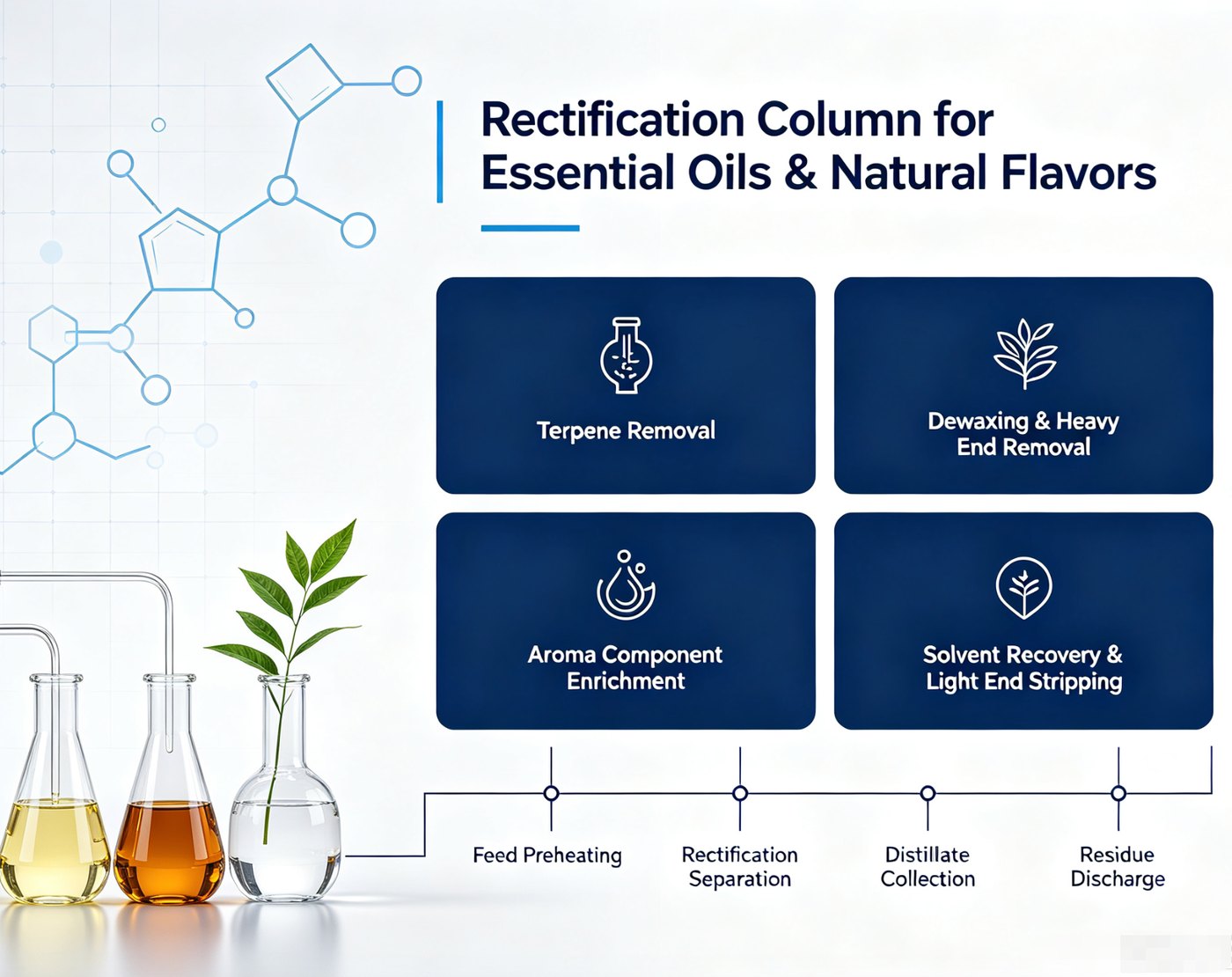
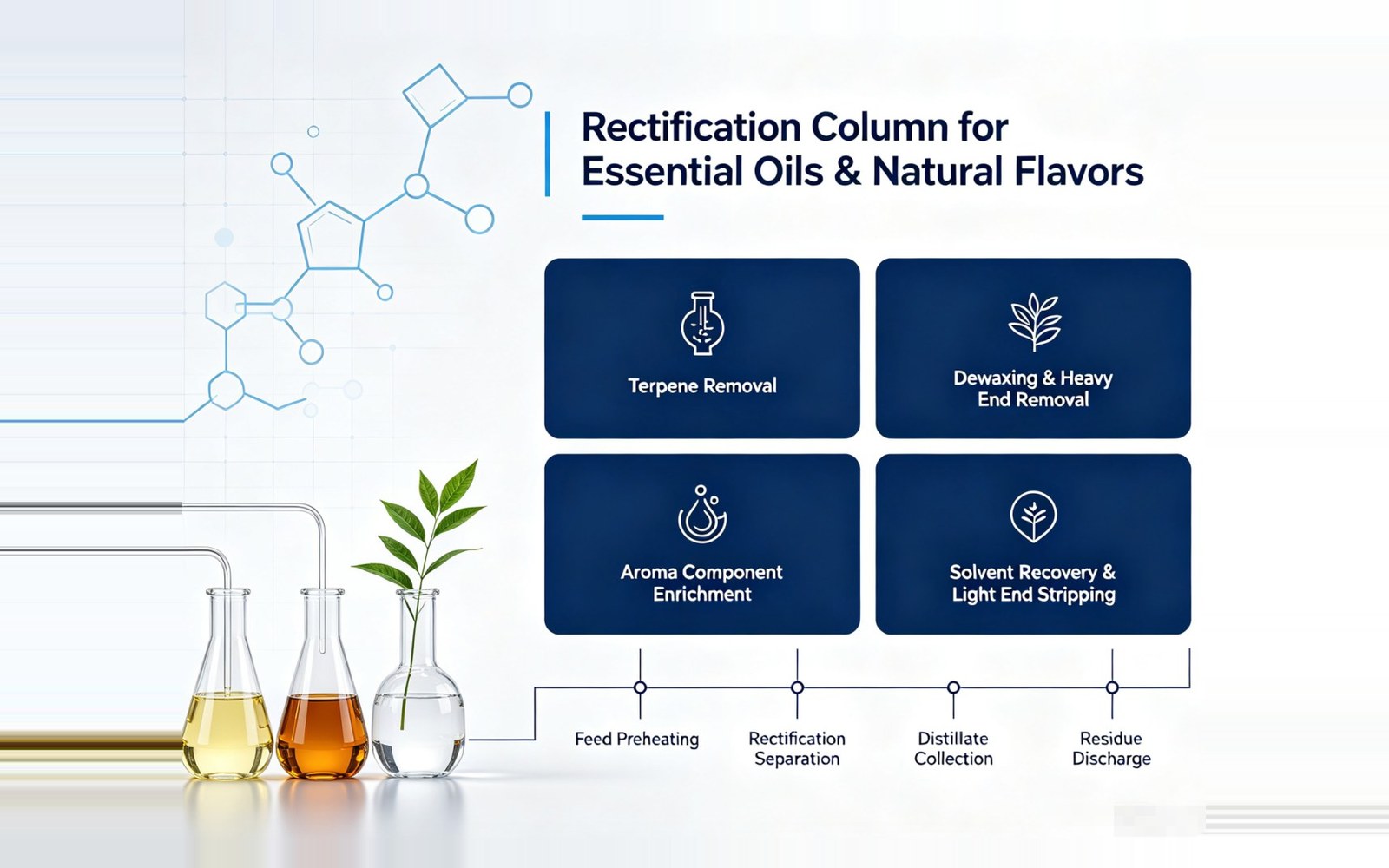
One counter-current column, four separation duties. Where a wiped-film still grades a material, a rectification column divides it — tray by tray, cut by cut — turning every difference in boiling point into a clean, collectable fraction. This brief maps the four core applications of the ANVORE rectification platform and the conditions each one needs.
- 01 Terpene Removal
- 02 Solvent Recovery & Light End Stripping
- 03 Aroma Component Enrichment
- 04 Dewaxing & Heavy End Removal
PLATFORM OVERVIEW
A rectification column separates by repeated evaporation and condensation: vapor rises through staged trays or packing, meets the descending liquid, and exchanges mass at every contact. The most volatile components enrich toward the overhead, the least volatile accumulate in the bottoms, and intermediate fractions can be drawn off along the column — one column therefore performs dozens of single-stage separations at once.
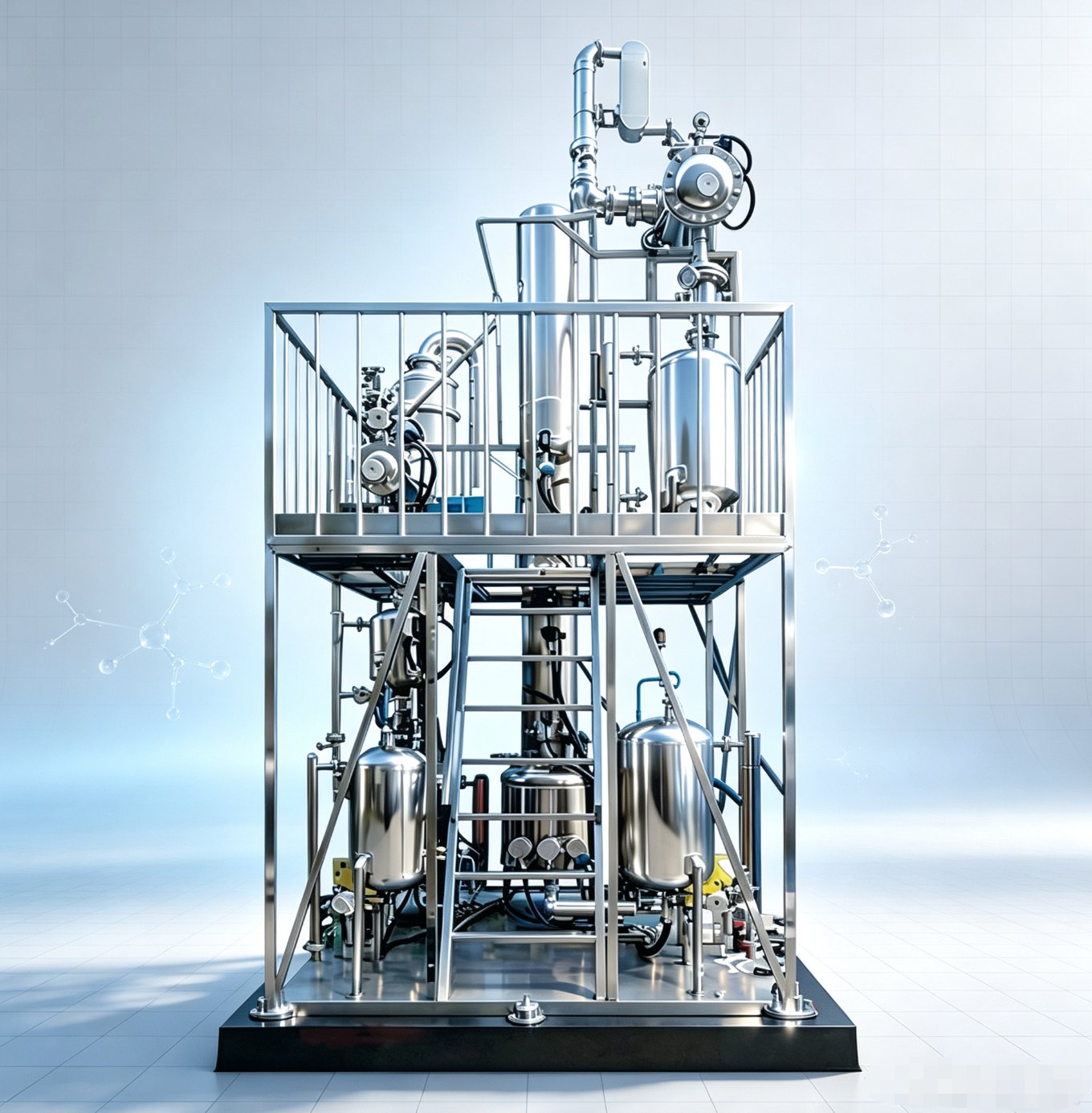
ANVORE rectification columns pair this counter-current principle with vacuum operation, tunable reflux and tight zone temperature control, in transparent glass for laboratory verification and stainless steel for production. The same platform serves four very different duties, defined simply by which cut is the product.
FOUR CORE APPLICATIONS
Each application below pairs the same column hardware with a different operating window and a different product cut:
1.TERPENE REMOVAL
| Challenge | Mono-terpenes and other highly volatile compounds dominate citrus, hemp and botanical extracts, driving instability, bitterness and off-notes in the finished product. |
|---|---|
| ANVORE Approach | A short rectification run at reduced pressure sweeps mono-terpenes and light aldehydes to the top of the column, where they leave as a clean overhead cut while the heavier, more valuable fraction is retained below. |
| Typical Conditions | Reduced pressure · moderate reflux · multi-plate staging |
| Outcome | Terpene-reduced, flavor-stable extract — plus a clean terpene by-product stream. |
2. SOLVENT RECOVERY & LIGHT END STRIPPING
| Challenge | Extraction solvents and residual light ends must be stripped to below regulatory limits — and recovered wherever possible to keep operating costs down. |
|---|---|
| ANVORE Approach | The column lifts solvent overhead at low reboiler temperature under vacuum while the product stream is polished below its residue limit; condensed solvent is returned to a closed loop for reuse. |
| Typical Conditions | Vacuum operation · low reboiler temperature · high reflux ratio |
| Outcome | Product within residue specification, solvent recovered for closed-loop reuse. |
3. AROMA COMPONENT ENRICHMENT
| Challenge | Aroma-active molecules sit in a narrow boiling window between lighter and heavier neighbors, and coarse distillation loses or degrades them. |
|---|---|
| ANVORE Approach | Fine tray staging and tunable reflux focus the cut on the narrow aroma window; a tight overhead or side-draw cut enriches the aroma fraction while its neighbors stay behind. |
| Typical Conditions | High tray count · tight reflux control · gentle vacuum |
| Outcome | Aroma fraction of markedly higher concentration with true-to-nature character. |
4. DEWAXING & HEAVY END REMOVAL
| Challenge | Waxes, resins and heavy ends raise viscosity, cloud the product and foul pumps, evaporators and columns downstream. |
|---|---|
| ANVORE Approach | Operating conditions keep heavy components from travelling up the column: they report to the bottoms and are discharged continuously, while overhead and side-draw streams stay clear and wax-free. |
| Typical Conditions | Controlled bottom temperature · continuous residue discharge |
| Outcome | Clear, winterized product with downstream equipment protected. |
APPLICATION COMPARISON AT A GLANCE
| Application | Separation zone | Process signature | Key outcome |
|---|---|---|---|
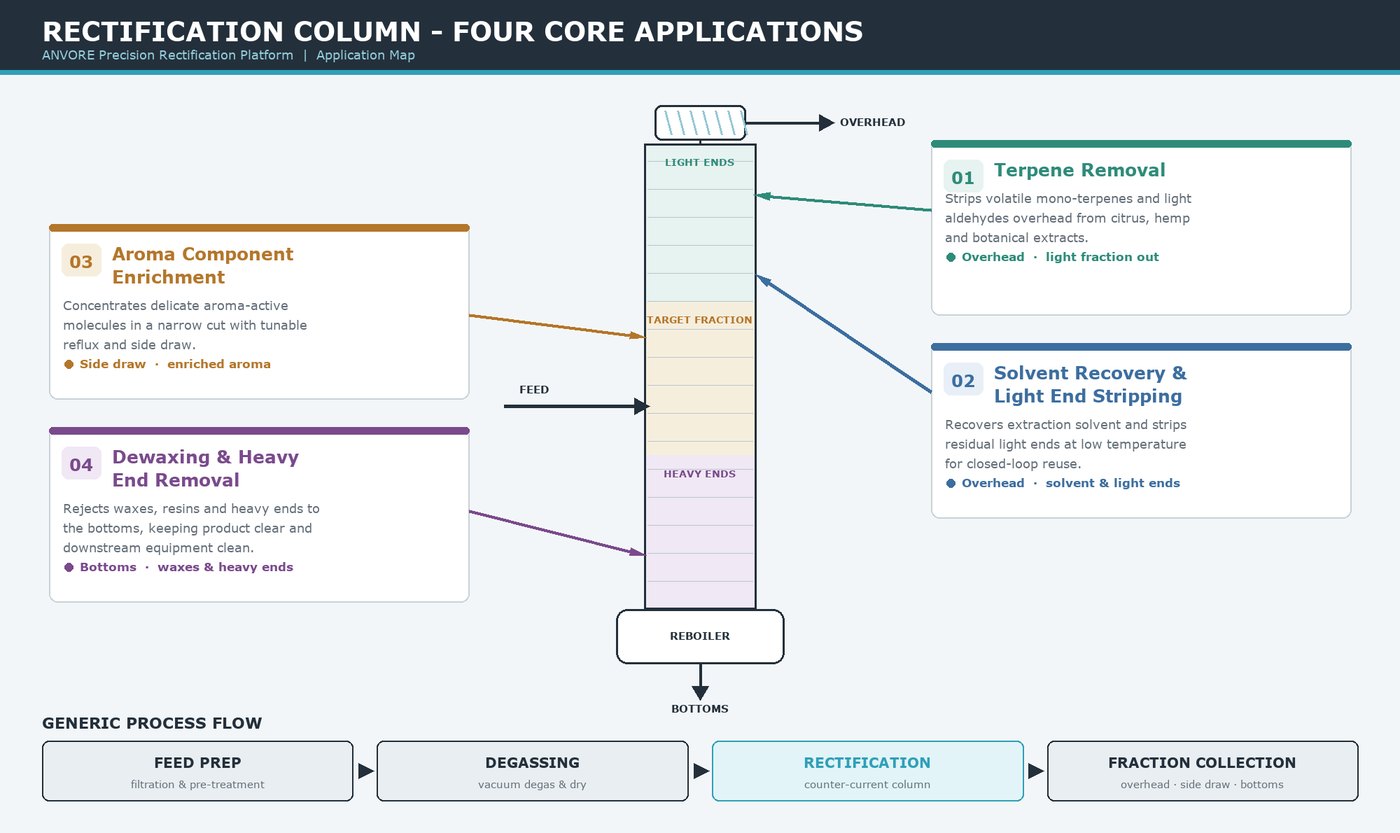
| 1 Terpene Removal | Overhead cut | Reduced pressure, moderate reflux | Terpene-reduced extract |
| 2 Solvent Recovery & Light End Stripping | Overhead cut | Vacuum, high reflux ratio | Low-residue product, solvent reused |
| 3 Aroma Component Enrichment | Side draw / narrow cut | High tray count, tight reflux | Enriched aroma fraction |
| 4 Dewaxing & Heavy End Removal | Bottoms | Bottom temperature control, continuous discharge | Clear, wax-free product |
HOW A CAMPAIGN RUNS - PROCESS FLOW
Whatever the application, every rectification campaign follows the same backbone — feed preparation, degassing, counter-current separation, fraction collection — with the product cut selected by the operating window, as mapped in Figure 2:
EQUIPMENT & ONE-STOP SUPPORT
ANVORE supplies the full rectification chain: transparent glass columns for laboratory verification, stainless-steel production columns with structured packing or trays, matched vacuum trains, reboilers and fraction receivers — plus process design, trial testing and on-site commissioning.
The four duties above rarely appear alone. A natural-extract campaign may strip solvent, remove terpenes, enrich aroma and reject wax in a single sequenced run — and ANVORE engineers the column, the conditions and the cut plan around exactly that sequence.
Tell us your feed composition and target fraction. ANVORE will run a free rectification trial and design the column and cut plan around it.