

Low-Temperature Vacuum Rectification with Thin-Film Polishing

How ANVORE's closed-loop separation platform strips extraction solvent and light-end impurities from floral concretes and oleoresins at aroma-safe temperatures — recovering the solvent for reuse while delivering a compliant, true-to-nature product.
| 50-200 mbar | 40-80 °C | ppm level | Closed loop |
|---|---|---|---|
| Rectification operating pressure | Reboiler temperature, aroma-safe | Residual solvent in product | Recovered solvent returned to extraction |
1. Application Overview
Jasmine, rose, tuberose and other precious flowers are too fragile for steam distillation, so the industry extracts them with food-grade solvents into concretes, then refines them into absolutes; spices and resins follow the same route into oleoresins and resinoids. Every one of these products carries the same burden: residual extraction solvent that must be removed to ppm-level regulatory limits — and recovered wherever possible, because solvent is one of the largest operating costs in extraction.
The challenge is thermal. The aroma molecules that give an absolute its value are the most volatile components present, and conventional solvent removal by simple evaporation strips them away together with the solvent, while high temperatures darken the product and generate off-notes. ANVORE solves both duties at once with low-temperature vacuum rectification followed by thin-film polishing: the solvent leaves overhead and is recovered for closed-loop reuse, while the aroma stays in the product stream.
2. The ANVORE Solution: Two Duties, One Platform
ANVORE pairs two complementary vacuum technologies so that solvent recovery and light-end removal each run in their optimum window:
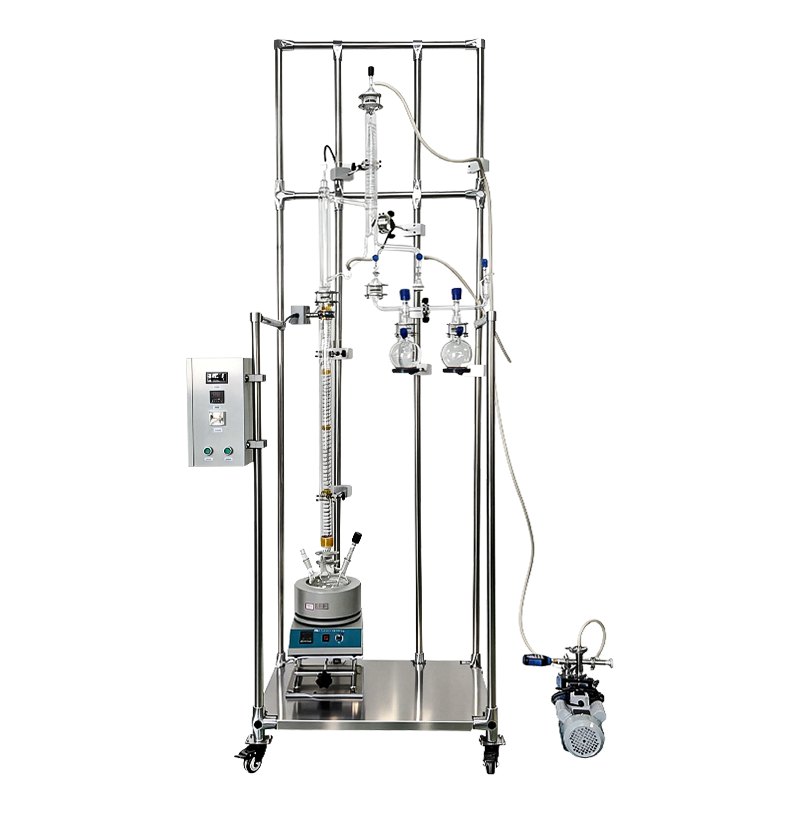
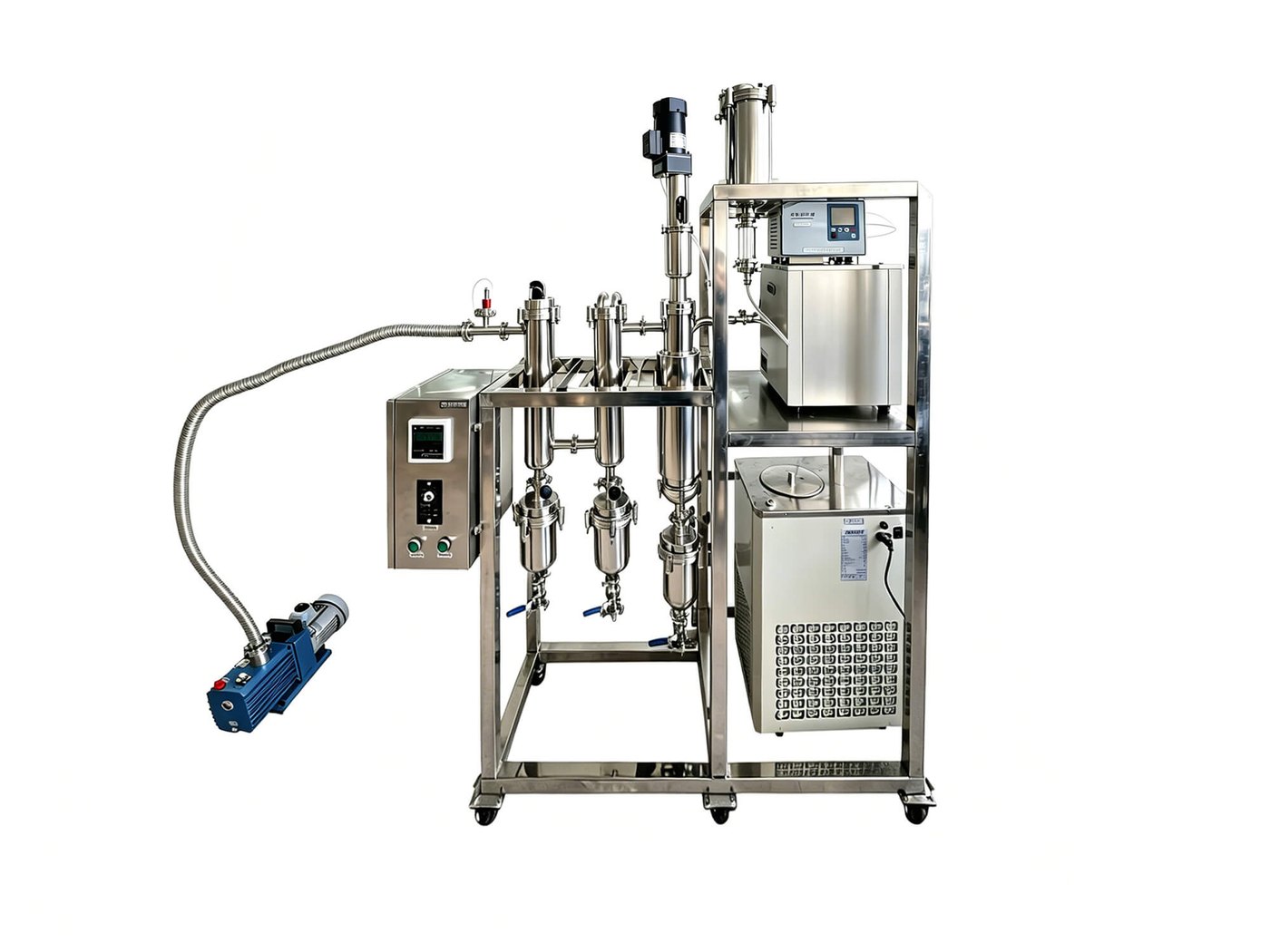
1. Vacuum rectification — solvent recovery —the dissolved feed enters a staged column operating under vacuum; extraction solvent, the most volatile component, enriches toward the overhead and leaves as a concentrated vapor that condenses into a clear, reusable solvent stream — at reboiler temperatures low enough to leave the aroma behind.
2. Thin-film evaporation — light end stripping —the product stream then passes a wiped-film evaporator, where high-speed wiper blades renew a thin falling film and strip the last traces of solvent and light off-notes overhead, polishing the product below its regulatory residue limit in seconds.
3. Hermetic, oxygen-free operation —the entire train runs closed under vacuum with a nitrogen blanket option — delicate aldehydes and esters never contact air, so color and top note survive the campaign.
4. One platform, tunable duty —the same equipment sequence handles jasmine-type concretes, spice oleoresins and resinoids by adjusting pressure, temperature and reflux — a single platform for the whole natural extract portfolio.
3. Complete Process Flow
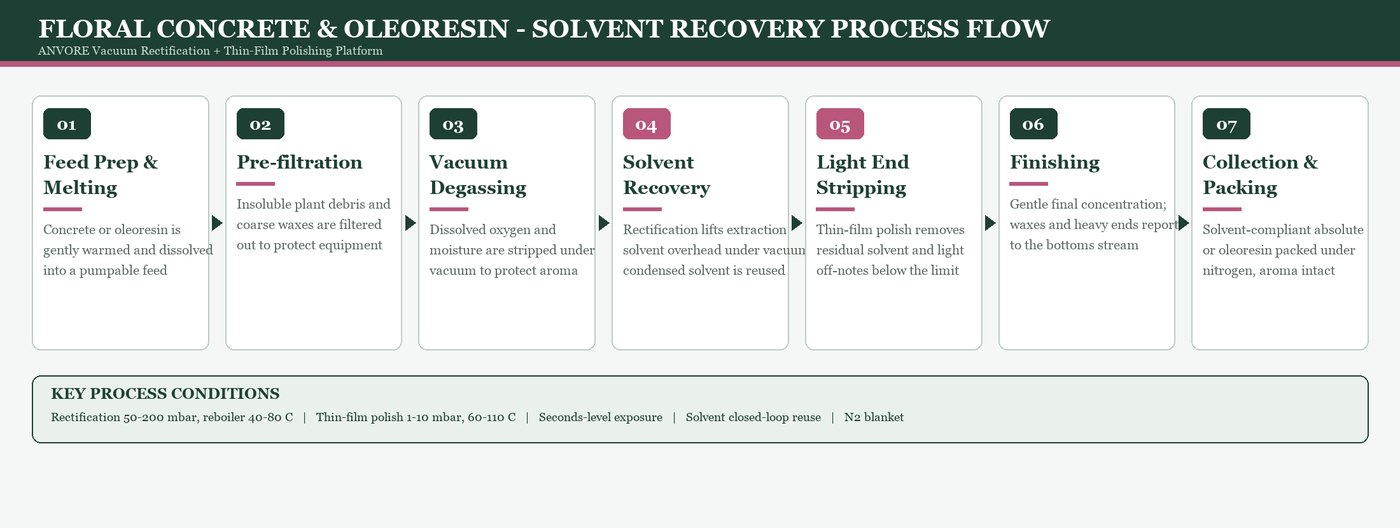
The campaign runs continuously; each stage below maps to the flow diagram in Figure 4:
Step 1 · Feed Preparation & Melting —The concrete or oleoresin is gently warmed just above its softening point and dissolved into a homogeneous, pumpable feed.
Step 2 · Pre-filtration —Insoluble plant debris and coarse waxes are filtered out, protecting the column packing and evaporator surfaces.
Step 3 · Vacuum Degassing —Dissolved oxygen and moisture are stripped under moderate vacuum — the first act of aroma protection before any heating.
Step 4 · Solvent Recovery —In the rectification column at 50-200 mbar, extraction solvent enriches overhead and condenses into the recovery receiver for closed-loop reuse; the aroma-rich stream continues downward.
Step 5 · Light End Stripping —The thin-film evaporator polishes the product stream, lifting residual solvent and light off-notes overhead to below the applicable residue limit within seconds.
Step 6 · Finishing —A gentle final concentration pass lets waxes and heavy ends report to the bottoms, leaving a clear, free-flowing absolute or oleoresin.
Step 7 · Collection & Nitrogen Packing —The finished product is discharged to sealed, nitrogen-blanketed receivers; recovered solvent is returned to the extraction loop.
4. Key Parameters & Process Advantages
| Parameter | Typical range / description |
|---|---|
| Feed | Floral concretes, absolutes-in-progress, spice oleoresins, resinoids |
| Rectification pressure | 50-200 mbar, vacuum column with reflux control |
| Reboiler temperature | 40-80 °C, always below aroma-damage thresholds |
| Thin-film polishing | 1-10 mbar, 60-110 °C, seconds-level residence |
| Residual solvent | Polished below the applicable regulatory limit |
| Product handling | Sealed receivers, nitrogen blanket, light-protected packing |
Compared with simple batch evaporation, the ANVORE route consistently delivers:
- Solvent that pays for itself — recovered solvent is condensed clean and returned to the extraction loop, cutting one of the largest operating costs.Compliance by design — thin-film polishing holds residual solvent below the applicable regulatory limit, batch after batch.Aroma that stays put — the most volatile, most valuable top notes remain in the product because separation happens at aroma-safe vacuum temperatures.Cleaner color and flavor — seconds-level thermal exposure prevents the darkening and cooked off-notes of conventional solvent stripping.
5. The Closed Loop: Recovery, Compliance, Yield
Solvent recovery is not only a compliance step — it is the economic heart of the campaign. Every litre of solvent lifted overhead in the rectification column is a litre that does not need to be purchased, stored or disposed of. ANVORE designs the condensation and receiver train so recovered solvent returns to extraction clean and dry, closing the loop between extraction and refining.
At the same time, the polished product stream meets the residue limits that global flavor and fragrance customers demand, and the gentle vacuum conditions preserve the yield of aroma compounds that simple evaporation would drive off. Compliance, cost and quality improve in the same pass.
6. Conclusion & One-Stop Support
Floral concretes and oleoresins deserve better than hot, open evaporation. The ANVORE platform removes solvent at aroma-safe temperatures, polishes the product below residue limits in seconds, and returns every litre of solvent to the loop — protecting the aroma, the audit and the budget in a single continuous campaign.
ANVORE provides free bench testing with your concrete or oleoresin, customized process design, complete equipment supply and on-site commissioning — scaling smoothly from laboratory glass units to stainless-steel production systems.
Send us your floral concrete or oleoresin sample for free verification. Contact ANVORE for tailored process design and equipment selection.