By Two-Stage Thin-Film Evaporation and Short-Path Molecular Distillation
How ANVORE's two-stage physical separation platform — wiped-film evaporation followed by short-path molecular distillation — purifies heat-sensitive fat-soluble vitamins under deep vacuum in seconds of residence time, preserving potency that high-temperature rectification destroys.
| 0.01-1 Pa | Seconds | 120-220 °C | 0 solvent |
|---|---|---|---|
| Deep-vacuum operating window | Thermal residence time | Gentle evaporation, tuned per vitamin | Purely physical separation |
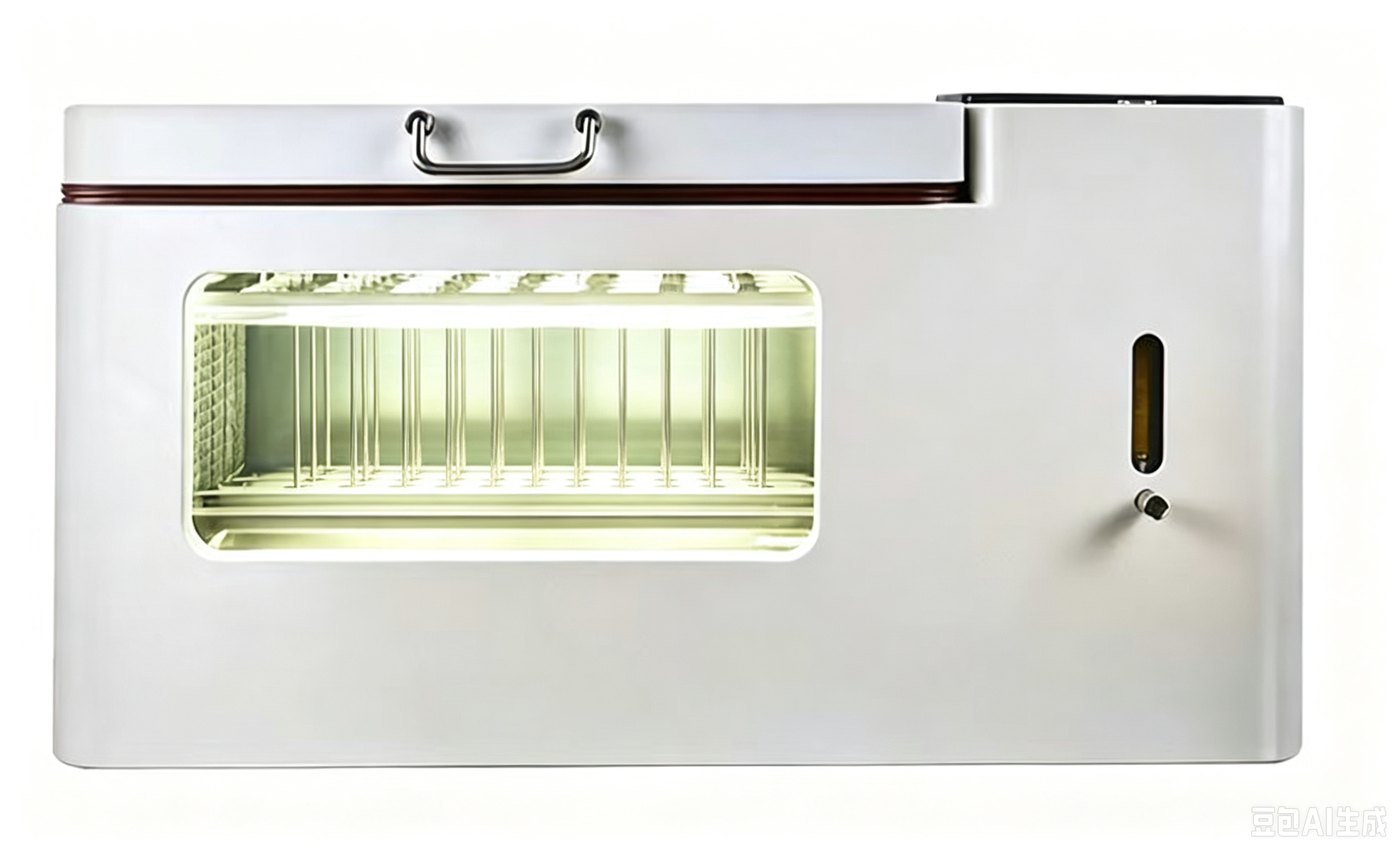
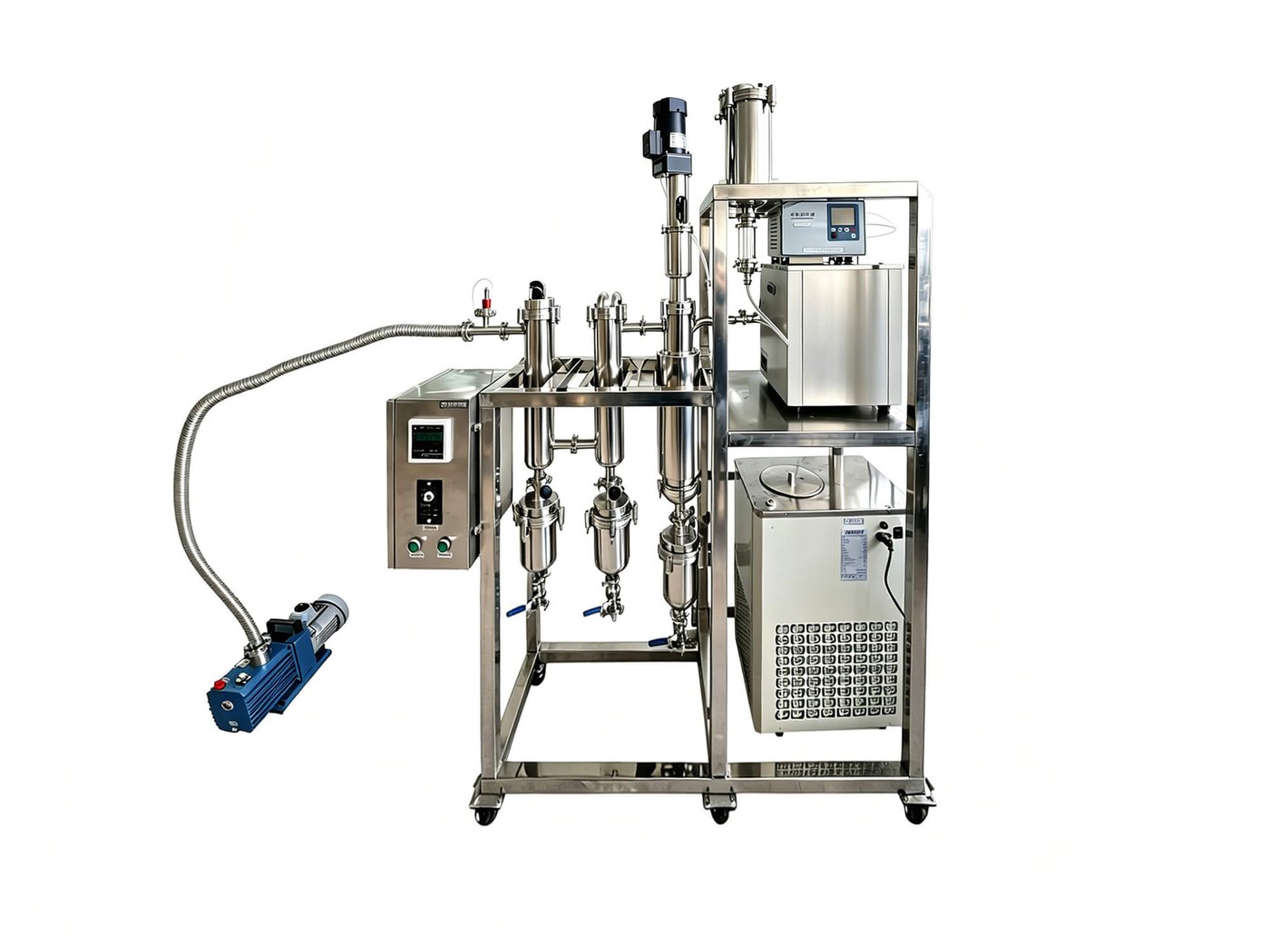
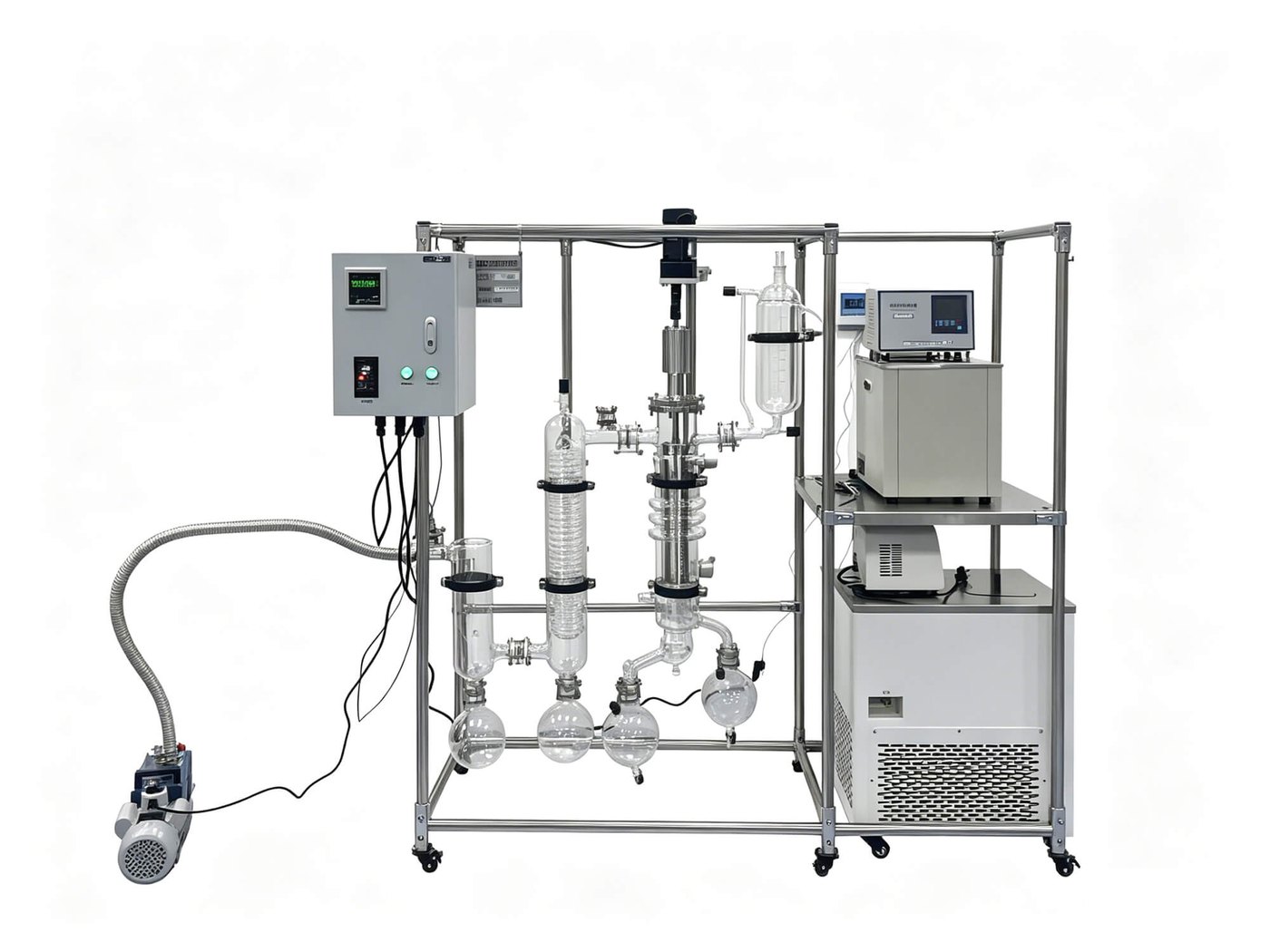
EQUIPMENT IN FOCUS ANVORE Two-Stage Vitamin Purification PlatformStage 1 — wiped-film evaporator strips light-end impurities.Stage 2 — short-path molecular distillation refines the vitamin fraction. Complete train: high-vacuum pumping unit, thermal-oil or jacketed heating, precision gear-pump feeding, low-temperature circulator and sealed, nitrogen-blanketed receivers.
1. Application Overview
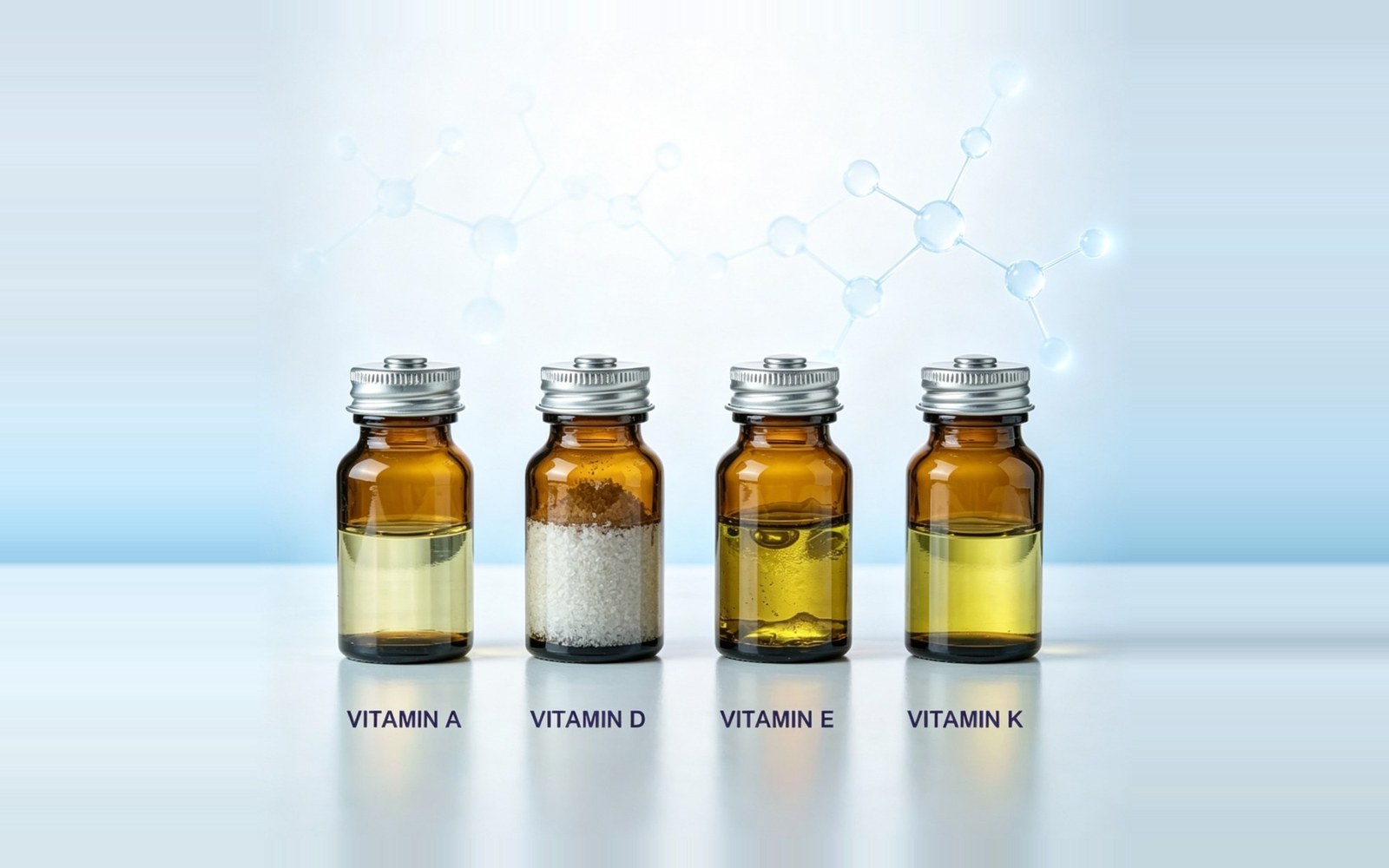
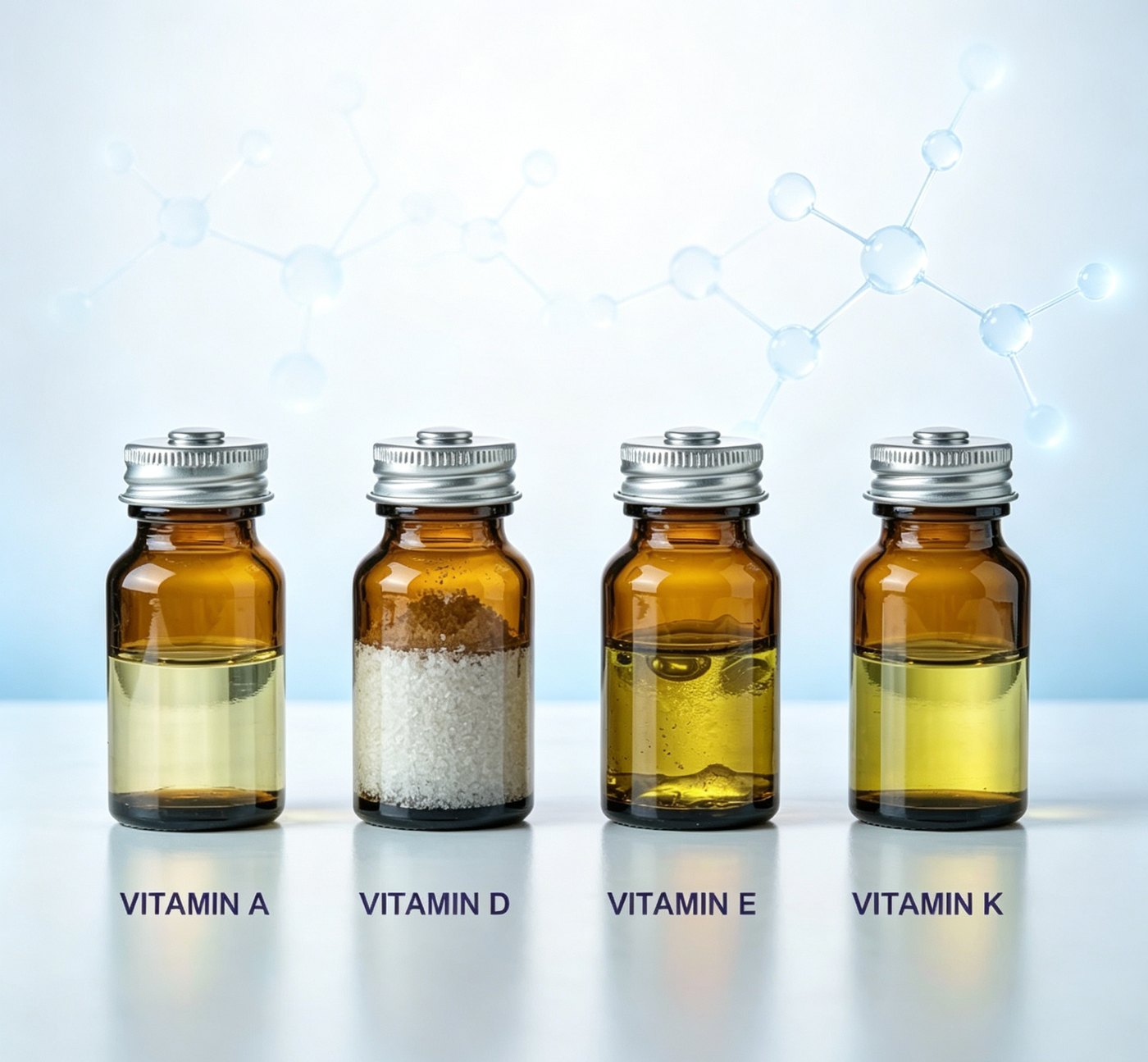
The fat-soluble vitamins A (retinyl esters), D (cholecalciferol), E (tocopherols) and K (phylloquinone / menaquinones) are high-value actives at the heart of pharmaceuticals, dietary supplements, food fortification and feed additives. They are also among the most fragile industrial products a plant can handle: high boiling points, multiple unsaturated double bonds, conjugated structures that isomerize under heat and light, and rapid oxidative degradation in the presence of air.
Conventional refining routes — atmospheric rectification, long-path vacuum distillation, solvent extraction and adsorption — expose these actives to high temperature, long hold-up times, oxygen ingress or solvent residues. The result is familiar: darker color, assay loss, isomer formation and off-spec batches.
ANVORE applies a two-stage, purely physical separation platform to the vitamin family: a wiped-film evaporator first strips light-end impurities under vacuum, then a short-path molecular distillation still refines the vitamin fraction at 0.01-1 Pa with only seconds of thermal exposure. The process preserves potency, delivers clear, light-colored distillates and scales cleanly from bench to production.
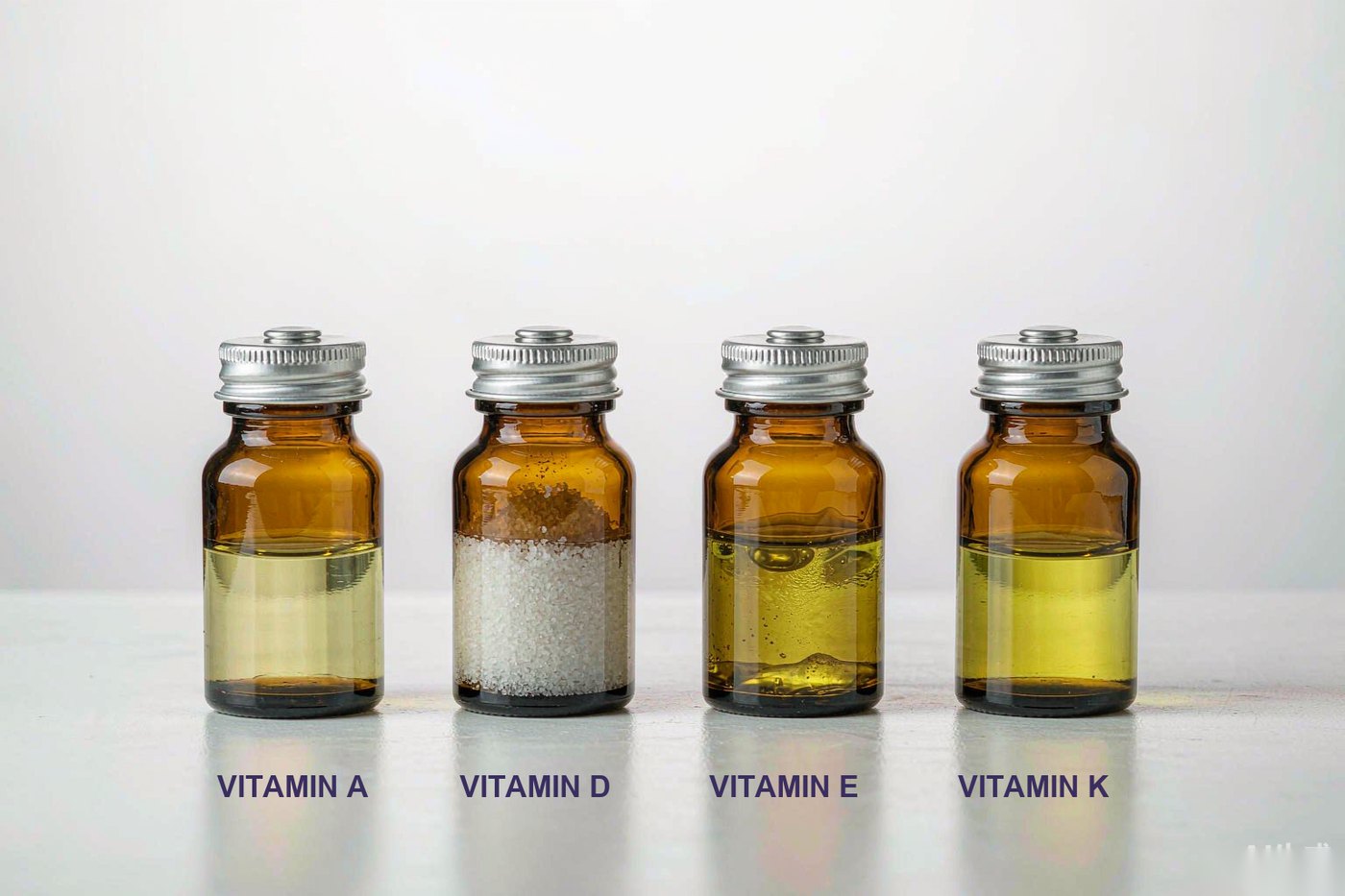
2. Why Vitamins A / D / E / K Are Hard to Purify
Four properties make this vitamin family a persistent purification challenge:
P1 · Thermal fragility —conjugated double-bond systems begin to decompose and isomerize well below their atmospheric boiling points; prolonged heating destroys assay and creates hard-to-remove isomer impurities.
P2 · High boiling points —retinyl esters, tocopherols and phylloquinone boil far above their decomposition temperature, so conventional distillation cannot reach the required vaporization temperature without destroying the product.
P3 · Complex crude matrices —synthetic crudes carry unreacted intermediates, homologs, pigments and polymers; natural vitamin E from soybean deodorizer distillate arrives mixed with fatty acids, sterols and glycerides.
P4 · Oxidation sensitivity —traces of oxygen and metal ions catalyze rapid oxidative darkening; every open handling step costs potency and color.
What vitamin producers need is gentle, oxygen-free, solvent-free physical separation with seconds — not hours — of thermal exposure, combined with the vacuum depth to vaporize high-boiling actives at survivable temperatures. That is precisely the design brief of the ANVORE two-stage platform.
3. The ANVORE Solution: Two-Stage Thin-Film + Molecular Distillation Platform
ANVORE sequences two complementary wiped-film technologies so that each operates in its optimum window:
1. Stage 1 · Wiped-film evaporation—the feed is spread into a thin falling film and the volatile light fraction — residual solvents, fatty-acid esters, water and low-boiling by-products — is evaporated at moderate vacuum and collected overhead, de-burdening the downstream stage.
2. Stage 2 · Short-path molecular distillation—the bottoms stream enters the short-path still, where the operating pressure of 0.01-1 Pa lets vitamin actives vaporize at only 120-220 °C and travel the mean-free-path distance to the internal condenser — heavy sterols, pigments and polymers never evaporate.
3. Hermetic, oxygen-free operation —both stages run fully closed and can be nitrogen-purged; the vitamin stream never contacts air, protecting color and potency.
4. Ultra-thin film, seconds of exposure —high-speed wiper blades renew the liquid surface continuously; the vitamin spends seconds on the hot wall instead of the long hold-up of batch rectification.
5. Gentle, precise thermal control —jacketed thermal-oil or water heating tracks each vitamin's narrow optimum window with tight tolerance — no hot spots, no scorching.
4. Complete Purification Process Flow
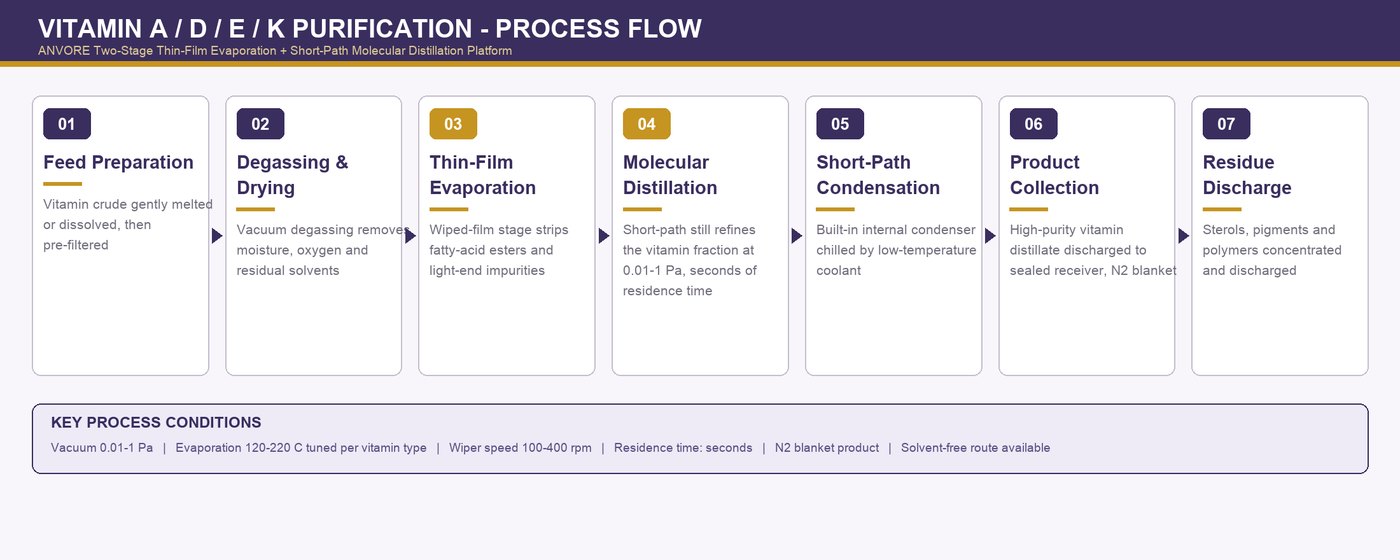
The purification campaign runs as a continuous, fully closed process. Each stage below maps to the flow diagram in Figure 4:
Step 1 · Feed Preparation —Crystalline or viscous vitamin crude is gently melted or dissolved (where required), pre-filtered to remove grit and protect the feed line.
Step 2 · Degassing & Drying —Under moderate vacuum the feed is degassed to strip dissolved oxygen, moisture and residual solvents — the first act of product protection.
Step 3 · Thin-Film Evaporation (Stage 1) —The wiped-film evaporator strips fatty-acid esters, solvent traces and light-end by-products overhead; the vitamin-rich bottoms continue forward.
Step 4 · Molecular Distillation (Stage 2) —In the short-path still at 0.01-1 Pa, vitamin actives vaporize from the wiped film within seconds and at the lowest practical temperature.
Step 5 · Short-Path Condensation —Vapors cross the mean-free-path gap to the built-in condenser, chilled by low-temperature coolant, and condense instantly — minimal back-mixing, maximum selectivity.
Step 6 · Product Collection —High-purity vitamin distillate is discharged to sealed receivers under a nitrogen blanket, ready for formulation or further polishing.
Step 7 · Residue Discharge —Sterols, pigments, polymers and non-volatile impurities concentrate at the still bottom and are discharged continuously.
Typical evaporation windows by vitamin type — Vitamin A (retinyl acetate / palmitate): 120-170 °C at 0.05-1 Pa · Vitamin D3: 120-160 °C at 0.1-1 Pa · Vitamin E (tocopherol): 160-220 °C at 0.1-1 Pa, with an optional esterification pre-treatment for natural VE from deodorizer distillate · Vitamin K1: 140-180 °C at 0.05-1 Pa. Multi-stage stills in series push assay to the highest grades.
5. Typical Operating Parameters
| Parameter | Typical range / description |
|---|---|
| Feed materials | Vitamin A (retinyl esters), vitamin D3, vitamin E (tocopherol), vitamin K1 crude or concentrates |
| Stage 1 | Wiped-film evaporator, moderate vacuum, light-end stripping |
| Stage 2 | Short-path molecular distillation, 0.01-1 Pa with diffusion pump |
| Evaporation temperature | 120-220 °C, tuned per vitamin type and target assay |
| Wiper speed | 100-400 rpm, uniform thin film |
| Residence time | Seconds on the heated surface |
| Condensation | Built-in internal condenser, low-temperature coolant |
| Product handling | Sealed receivers, nitrogen blanket, light-protected |
| Separation principle | Purely physical; solvent-free route available |
6. Process Advantages & Typical Outcomes
Bench and production experience across the vitamin family consistently shows:
- Potency preserved —low-temperature, seconds-long exposure suppresses decomposition and isomerization, keeping assay and bioactivity at the level the crude was synthesized or extracted to deliver.
- Purity and color uplifted —light-end odors, fatty impurities, sterols, pigments and polymeric residue are physically stripped; distillates run clear and light-colored.
- Yield improved —gentle conditions eliminate the thermal-cracking losses of hot rectification, lifting the recovery of target actives.
- Clean-label process —purely physical separation with no chemical reagents; a solvent-free route removes solvent-residue concerns for pharma and supplement grades.
- Continuous, scalable, GMP-ready —closed continuous operation with stable repeatability scales directly from bench glass units to stainless-steel production trains; stainless wetted parts and clean-in-place design suit GMP environments.
7. Equipment Selection & Scale-Up Path
ANVORE offers a graded equipment portfolio covering every stage of vitamin production:
- Laboratory R&D and parameter screening — glass molecular distillation units: transparent vessels for real-time observation of film and distillate, quick disassembly and cleaning.Pilot and continuous production —wiped-film evaporators and stainless-steel molecular distillation systems: higher throughput, closed sealing, weak-corrosion resistance and industrial scale-up.Supporting services — free bench testing with your material, customized two-stage process design, complete equipment supply, and on-site installation, commissioning and operator training.
8. Conclusion & One-Stop Support
For fat-soluble vitamins A, D, E and K, purification is a race against heat, oxygen and time. The ANVORE two-stage platform wins that race by design: a wiped-film evaporator removes the light burden under moderate vacuum, and short-path molecular distillation refines the vitamin fraction at 0.01-1 Pa within seconds of thermal exposure — preserving potency, color and yield that conventional routes surrender.
ANVORE is a dedicated manufacturer of molecular distillation, thin-film evaporation and related separation equipment serving pharmaceutical, nutrition, fine chemical and new-material producers worldwide. If your vitamin stream — or any heat-sensitive high-boiling intermediate — needs a gentler purification route, send us a sample: bench verification data can be in your hands quickly.
Need sample testing or an equipment proposal? Contact ANVORE for free material verification, tailored process design and one-to-one equipment selection.