By Short-Path Molecular Distillation for Pharmaceutical Intermediate Production
How a pharmaceutical enterprise turned dark, thermally unstable crude alkylquinoline into a light-colored, high-purity pharmaceutical intermediate — using low-temperature, high-vacuum short-path molecular distillation to replace carbonizing high-temperature rectification.
| 1-5 Pa | 400 rpm | Seconds | 0 solvent |
|---|---|---|---|
| Ultimate vacuum with diffusion pump | Wiped-film rotor speed | Thermal residence time | Purely physical separation |
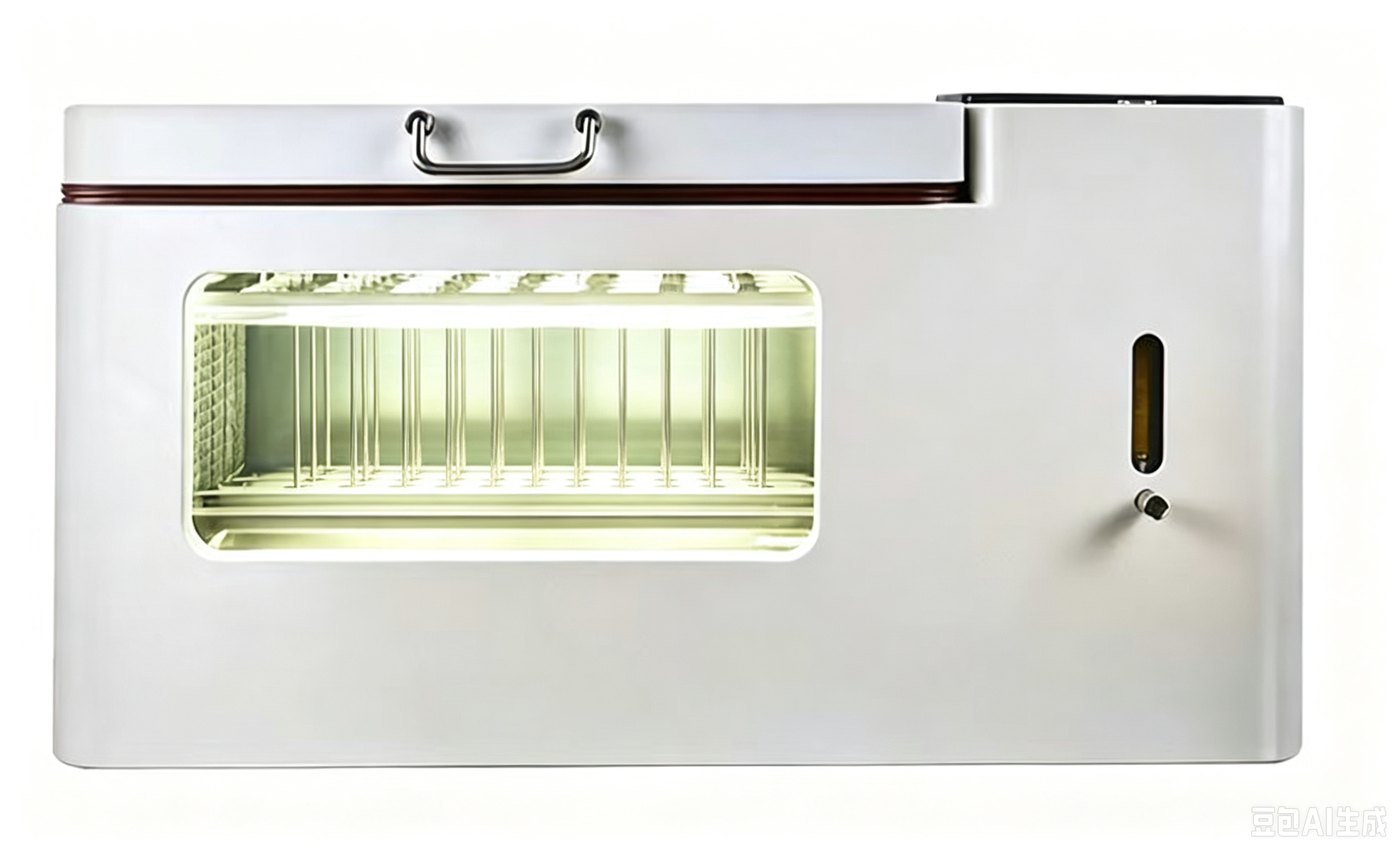
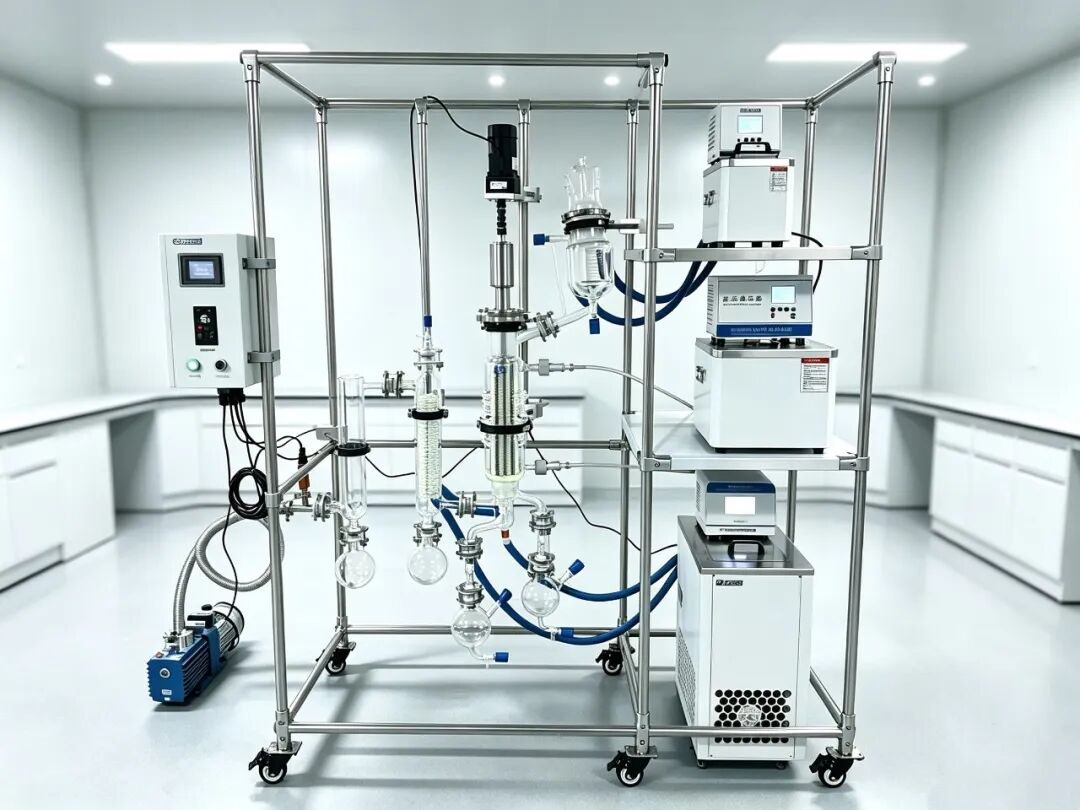
EQUIPMENT IN FOCUS Glass wiped-film short-path molecular distillation systemComplete bench unit with high-vacuum pumping train, thermal-oil temperature control, continuous gear-pump feeding, low-temperature circulator chilling and sealed receivers — transparent glass evaporator for real-time observation of film formation and distillation.
1. Application Overview
Alkylquinoline derivatives are an important family of nitrogen-containing heterocyclic compounds. As pharmaceutical intermediates they serve as key building blocks for active pharmaceutical ingredients and fine chemicals; the same family also finds use in extraction agents, rubber additives and specialty flavors. Chemically, however, they are notoriously difficult streams: high atmospheric boiling points, an oxidation-prone quinoline ring, and strong tendency to discolor, polymerize and decompose under prolonged heating.
ANVORE recently completed a bench-scale purification campaign for a pharmaceutical enterprise producing alkylquinoline derivatives as pharmaceutical intermediates. The customer's crude synthesis product could not meet downstream quality targets with conventional vacuum rectification: the product carbonized at high temperature and purity fell short of specification.
Using an glass wiped-film short-path molecular distillation system, ANVORE engineers validated a low-temperature, high-vacuum separation route that removes both light-end impurities and heavy tar while keeping the heat-sensitive quinoline ring intact — delivering a light-colored refined product with significantly improved active content.
2. Why Crude Alkylquinoline Is Hard to Purify
The customer's existing batch vacuum rectification process faced four chronic problems:
P1 · High-temperature oxidation —alkylquinoline boils high, so rectification demands sustained high-temperature heating; long thermal exposure oxidizes the quinoline ring and darkens the product.
P2 · Complex impurity profile —the crude contains unreacted raw materials, multi-alkylated homologs and high-molecular tar, which ordinary rectification struggles to resolve.
P3 · Polymerization and coking —at high temperature the material polymerizes into colloidal residue, depressing the yield of the target product.
P4 · Unstable product quality —finished purity failed to meet downstream pharmaceutical-intermediate standards, with batch-to-batch color variation.
Requirement: minimize material degradation while stripping light-end impurities and heavy tar, raise the active alkylquinoline content, obtain a light-colored refined product — and verify at bench scale that the process can be scaled up to pilot production.
3. The ANVORE Solution: Glass Wiped-Film Molecular Distillation System
Matching the material's high-boiling, heat-sensitive and oxidation-prone character, ANVORE engineers selected the glass wiped-film short-path molecular distillation system for the bench campaign. Each design feature answers a specific pain point:
1. Hermetic high-vacuum operation —the closed system is evacuated to 1-5 Pa and isolated from air, suppressing oxidation and discoloration of the quinoline ring.
2. Ultra-thin wiped film —high-speed wiper blades spread the feed into an ultra-thin liquid film; material is heated for only seconds, drastically reducing side reactions.
3. Built-in short-path condenser —vapors condense on the internal condenser within the shortest possible path, minimizing molecular back-mixing and losses.
4. Transparent glass evaporator —film formation and distillate flow can be observed in real time, enabling fast, precise parameter optimization.
5. Complete supporting train —high-vacuum pumping unit, thermal-oil temperature control, continuous gear-pump feeding, low-temperature circulator and sealed receivers — a turnkey bench platform.
4. Complete Purification Process Flow
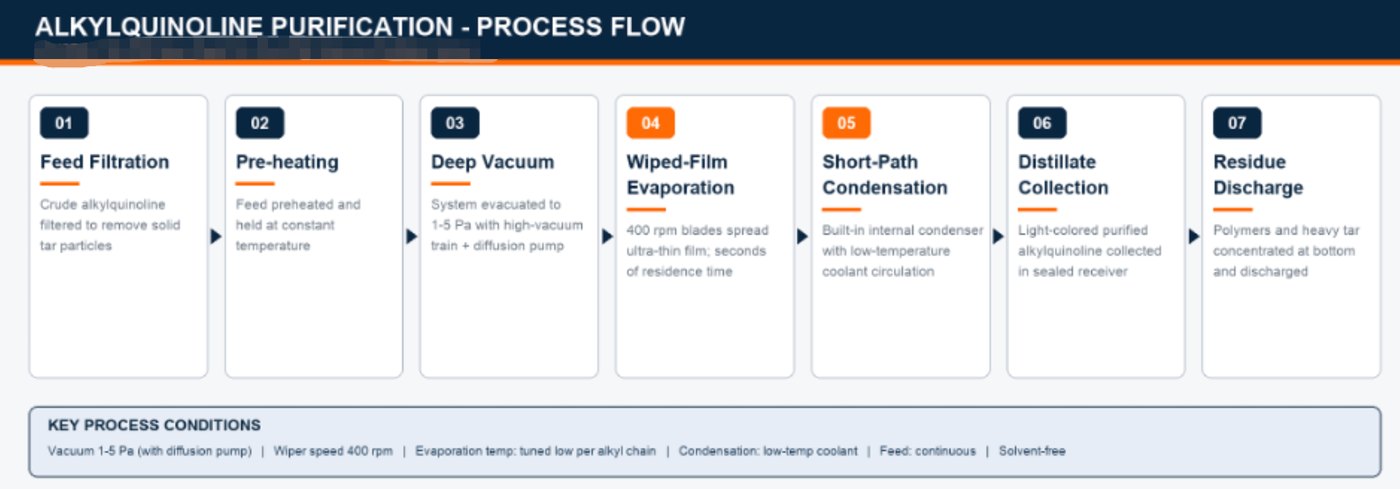
Before distillation, the crude synthesis product is pre-filtered to remove solid tar particles and prevent feed-line blockage. The separation itself then runs as a continuous process — each stage below maps to the flow diagram:
Step 1 · Feed Filtration —Crude alkylquinoline is filtered to remove solid tar particles and protect the feed line.
Step 2 · Pre-heating —The filtered feed is preheated and held at a stable temperature for smooth, consistent feeding.
Step 3 · Deep Vacuum —The high-vacuum train with diffusion pump evacuates the system to 1-5 Pa, slashing the boiling point.
Step 4 · Wiped-Film Evaporation —At 400 rpm the wiper blades spread an ultra-thin film on the heated wall; volatile components evaporate within seconds of residence time.
Step 5 · Short-Path Condensation —Vapors travel the short distance to the built-in internal condenser and are chilled by low-temperature coolant.
Step 6 · Distillate Collection —The purified, light-colored alkylquinoline distillate is collected in the sealed light-phase receiver.
Step 7 · Residue Discharge —Polymers and heavy tar concentrate at the evaporator bottom and are discharged continuously.
For requiring higher purity, a second molecular distillation stage can be added in series to strip residual trace isomeric impurities from the first-pass distillate.
5. Typical Operating Parameters (Bench-Trial Range)
| Parameter | Typical range / description |
|---|---|
| Feed | Crude alkylquinoline derivative synthesis product, pre-filtered |
| System ultimate vacuum | 1-5 Pa, high-vacuum train with diffusion pump |
| Evaporation temperature | Tuned to the alkyl-chain type; kept low to avoid thermal decomposition |
| Wiper speed | 400 rpm, forming a uniform thin liquid film |
| Feed rate | Stable continuous feeding via gear pump |
| Condensation temperature | Low-temperature coolant circulation for full recovery |
| Residence time | Seconds |
| Separation principle | Purely physical; no organic solvent added, no solvent residue |
6. Bench-Trial Results
The bench campaign on the customer's crude alkylquinoline stream met every target:
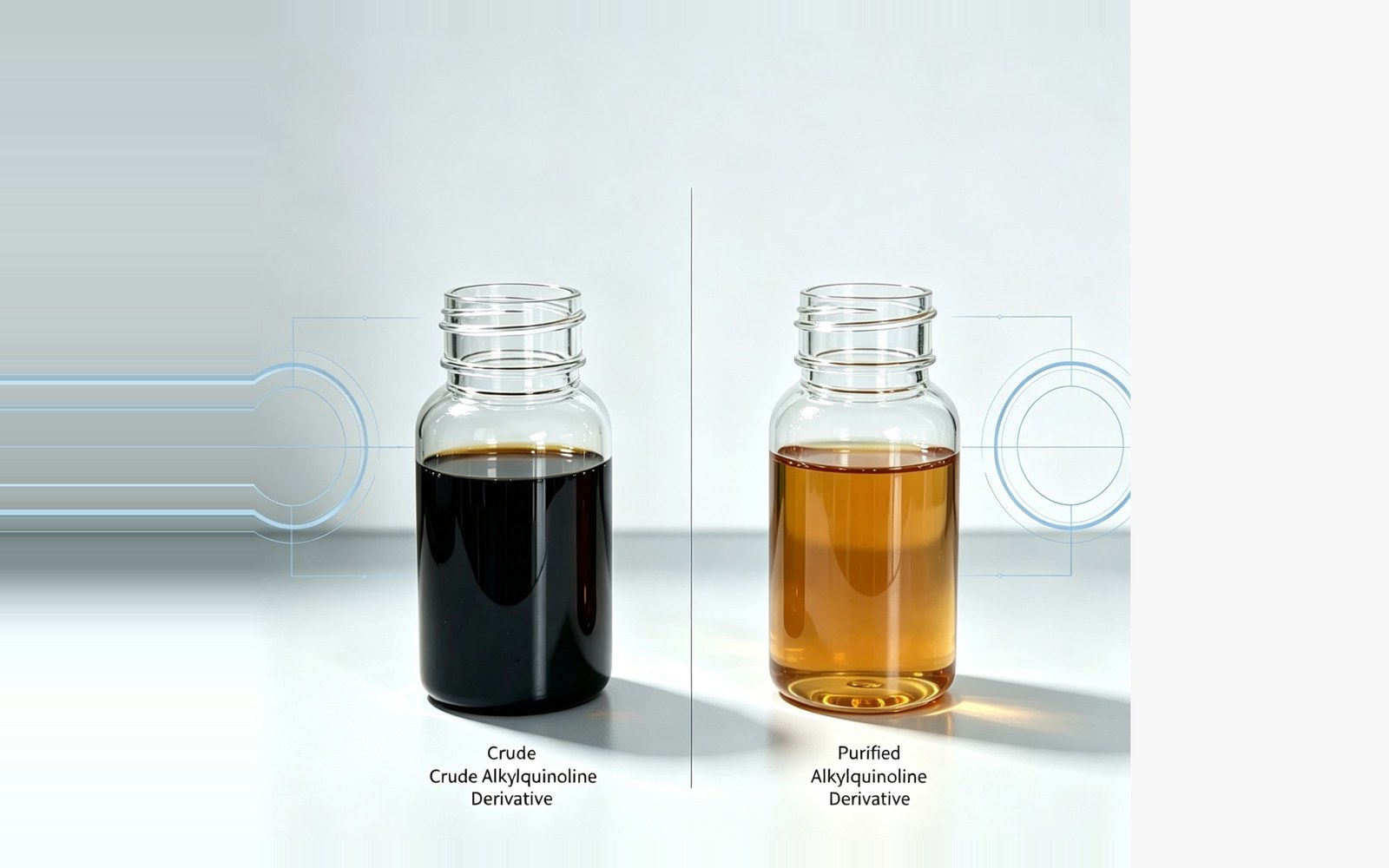
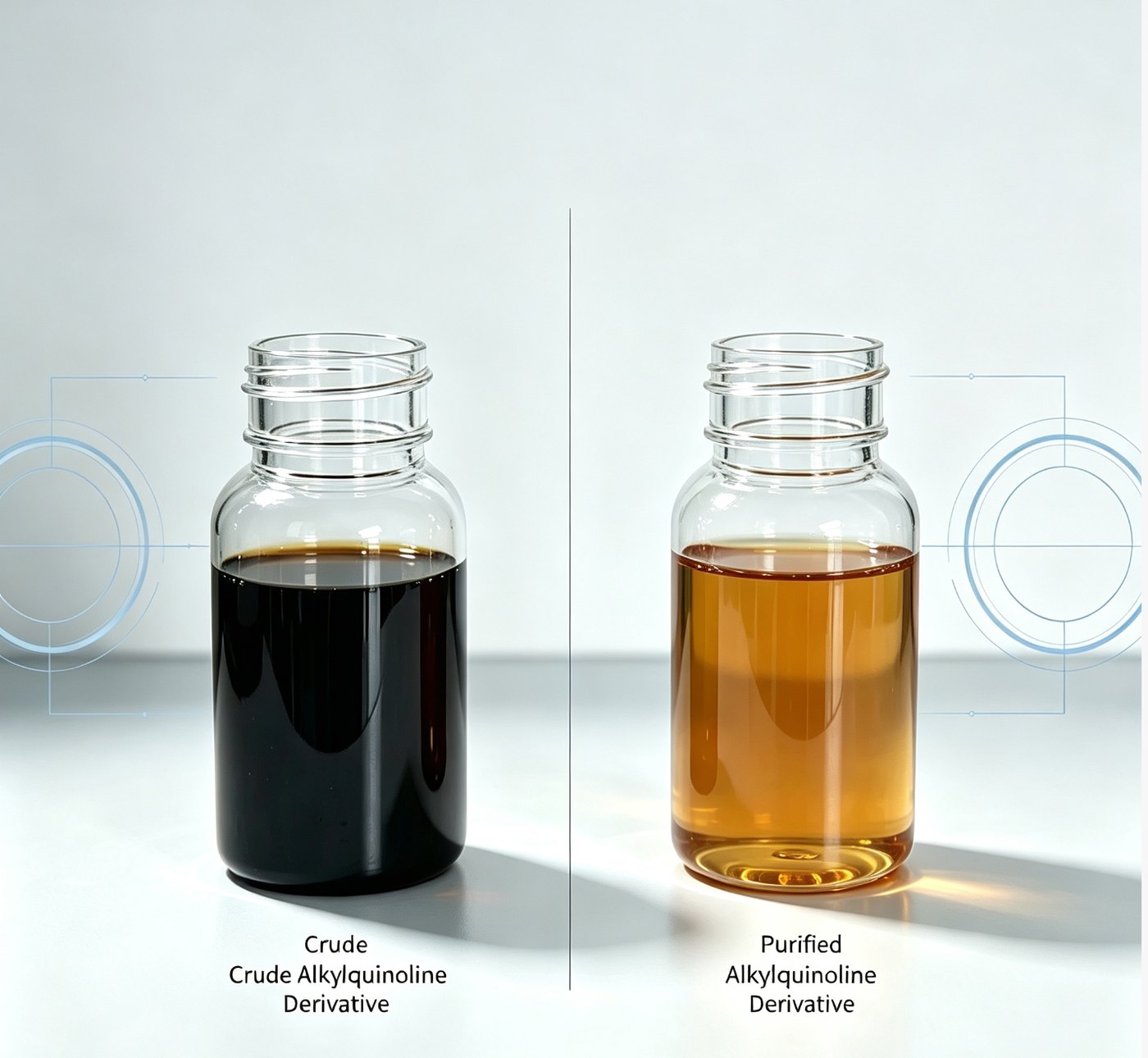
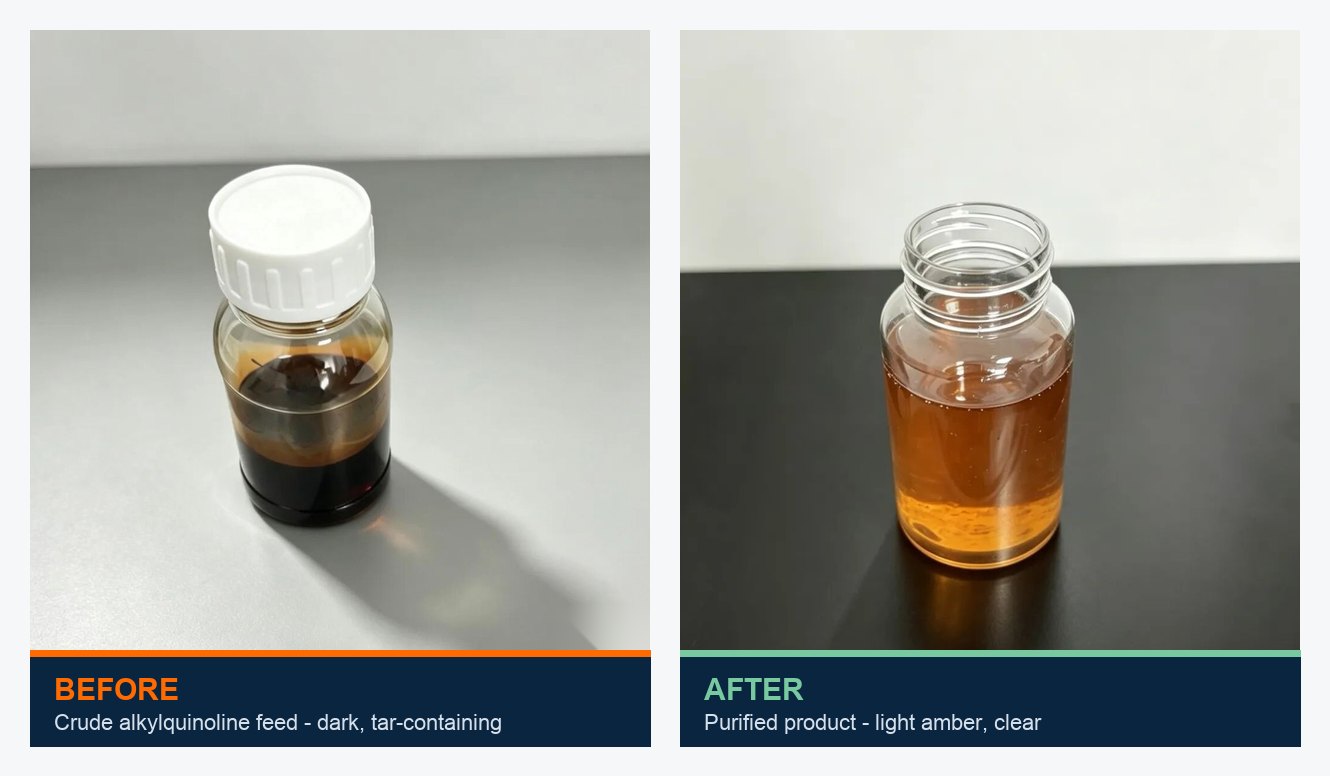
- Appearance restored —the refined alkylquinoline is dramatically lighter in color, resolving the yellowing and darkening caused by high-temperature oxidation.
- Purity uplifted —active component content rose significantly and heavy tar impurities were essentially removed — meeting downstream pharmaceutical-intermediate specifications.
- Yield optimized —versus vacuum rectification, thermal-cracking losses were eliminated and the yield of target product improved markedly.
- Clean, repeatable process —purely physical separation with no organic solvent and no solvent residue; continuous operation with good batch-to-batch repeatability.
Feedback: the ANVORE bench trial achieved the expected results and qualified samples were delivered. The customer will use this data set to optimize parameters further and move forward with pilot-scale equipment selection.
7. Equipment Selection & Scale-Up Path for Alkylquinoline Streams
ANVORE offers a graded equipment portfolio covering every stage from lab research to continuous production:
- Laboratory R&D and process development —glass molecular distillation units: transparent vessels, quick disassembly and cleaning, ideal for formulation and parameter screening.Pilot and continuous production —stainless-steel molecular distillation systems: higher throughput, superior closed sealing and weak-corrosion resistance, ready for industrial scale-up.Supporting services — free bench testing of your material, customized process design, complete equipment supply, and on-site installation and commissioning guidance.
8. Conclusion & One-Stop Support
In pharmaceutical intermediates, extraction agents and heterocyclic fine chemicals, high-boiling heat-sensitive materials are steadily abandoning traditional high-temperature rectification. The purification practice for oxidation-prone alkylquinoline derivatives proves it again: the low-temperature, short-residence, high-vacuum character of short-path molecular distillation is the reliable route to upgrading heat-sensitive organic materials.
ANVORE has deep expertise in separation and purification equipment. Its molecular distillation and thin-film evaporation lines serve fine chemical, pharmaceutical and biomedical, and new-material producers worldwide. If you face purification challenges with quinoline derivatives, pyridine derivatives, high-boiling intermediates or similar streams, send us your sample — bench verification data can be in your hands quickly.
Need sample testing or an equipment proposal? Contact ANVORE for free material verification, tailored process design and one-to-one equipment selection.