
Molecular Distillation Troubleshooting: Common Problems and Proven Solutions
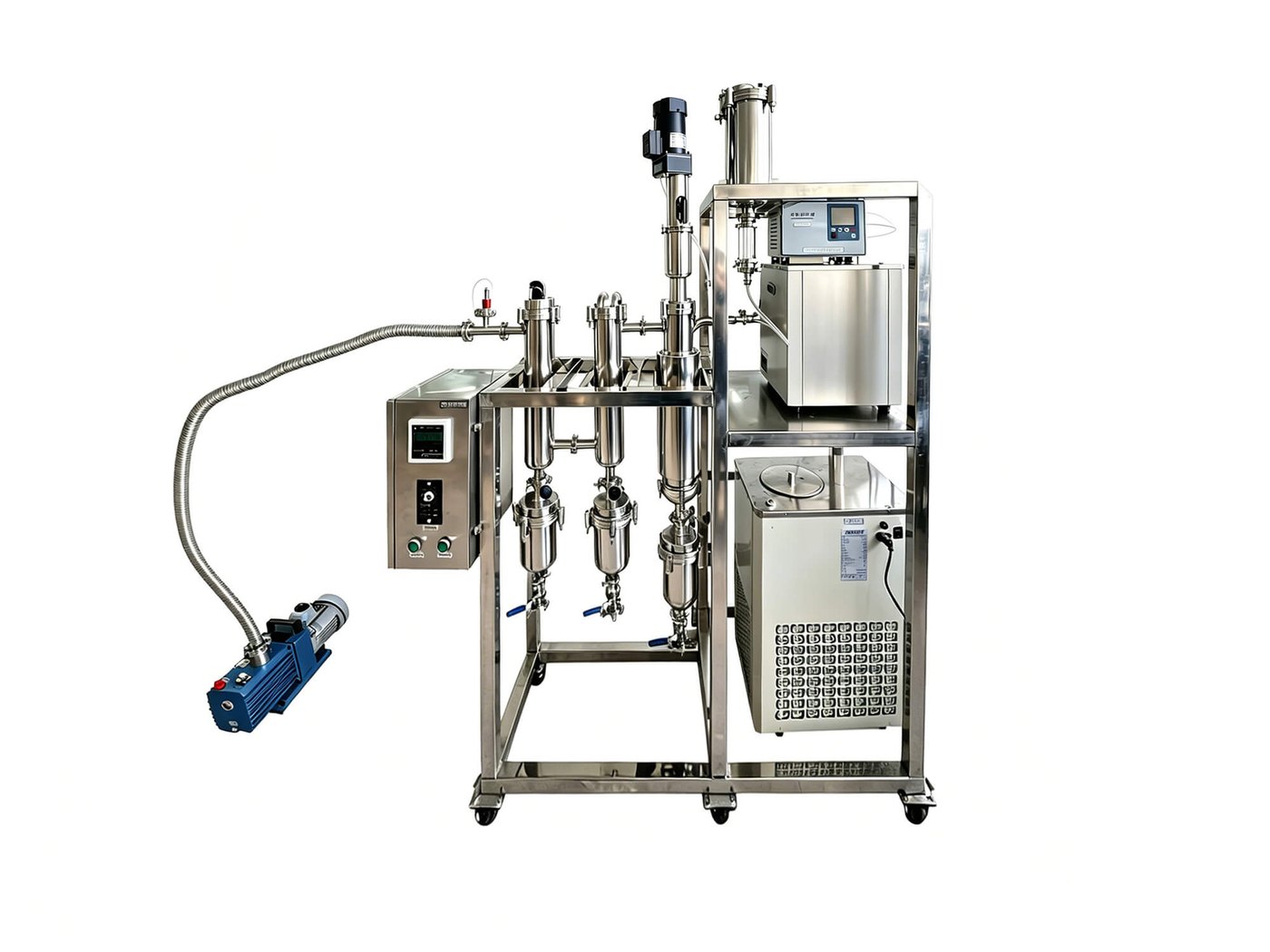
A practical field guide to keeping ANVORE short-path molecular distillation systems running efficiently, safely and productively.
1. Introduction
Short-path molecular distillation is one of the gentlest ways to separate heat-sensitive, oxidizable and high-boiling materials. Yet, like any precision separation process, results can drift when operating conditions, support equipment or maintenance are not optimized. This guide walks through the symptoms, root causes and corrective actions our application engineers most often encounter in the field.
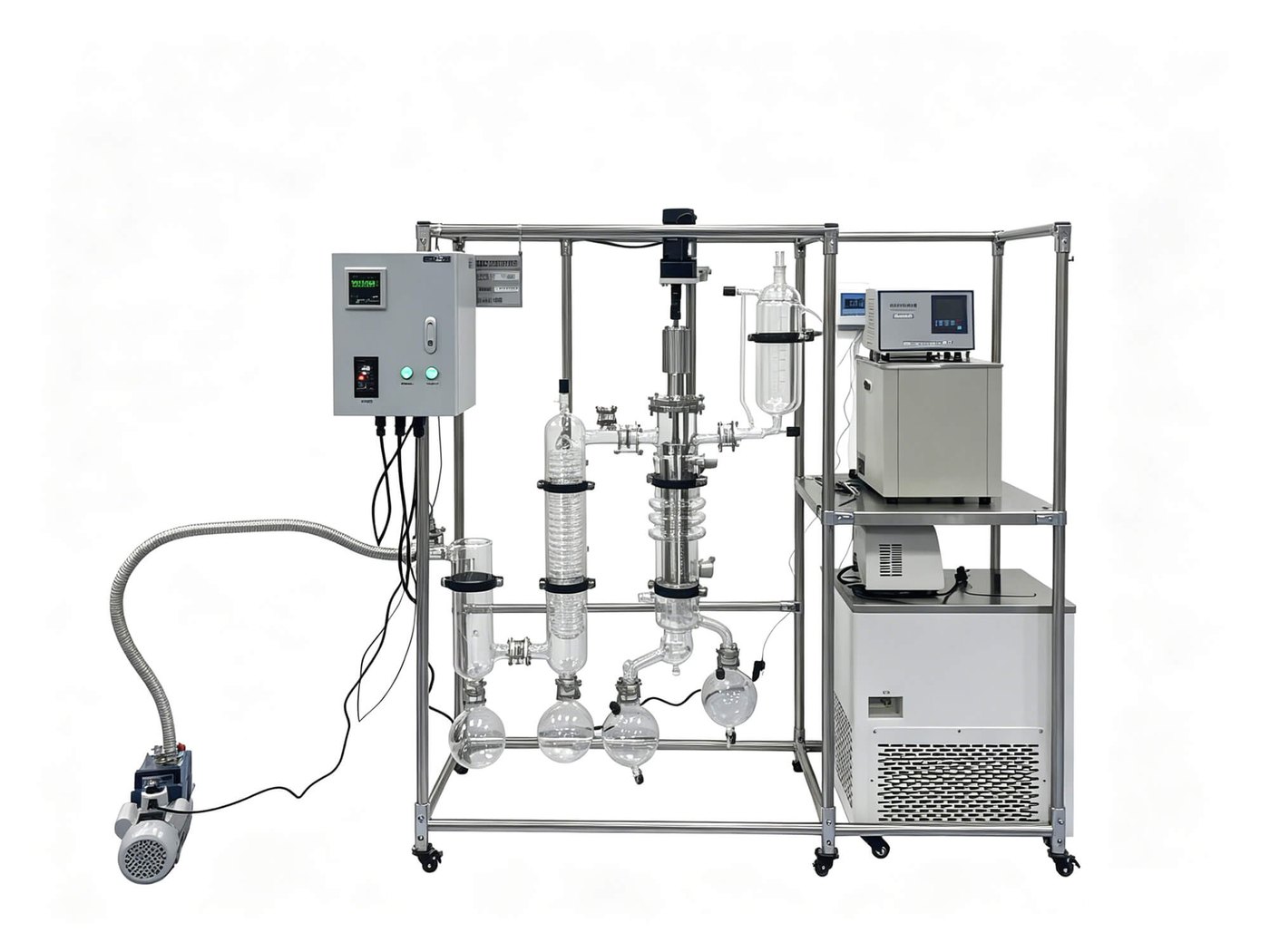
The recommendations below apply to ANVORE glass and stainless-steel short-path molecular distillation systems. Many are universal principles that will also help you diagnose other wiped-film or thin-film evaporator setups.
2. Quick Diagnosis Table
Use the table below to identify the most likely cause and first corrective action for common field symptoms.
| Symptom | Most likely causes | First action |
|---|---|---|
| Vacuum will not reach set point | Air leak, saturated cold trap, contaminated pump oil, outgassing feed | Leak-check joints; regenerate cold trap; change pump oil; degas feed |
| Low distillate yield / no light fraction | Evaporation temperature too low, feed rate too high, condenser too warm | Raise jacket temperature; reduce feed rate; lower condenser temperature |
| Product darkening or off-odor | Overheating, oxygen ingress, long residence time, reactive metal surface | Lower temperature; nitrogen purge; increase rotor speed; use SS316 or glass path |
| Foaming / liquid surge into vacuum line | Dissolved gases, high feed rate, viscous or surfactant-rich feed | Degas feed; reduce feed rate; add antifoam or pre-flash |
| Wax / solid buildup on condenser | Condenser too cold, high-melting fraction condensing | Raise condenser above melting point; clean between batches |
| Cross-contamination between fractions | Poor film distribution, carryover, shared receivers | Optimize wiper speed; lower feed rate; clean receivers |
| Temperature overshoot or unstable control | Circulator fault, sensor drift, poor insulation, PID tuning | Calibrate sensors; check circulator fluid; inspect insulation |
| Rotor noise, vibration or uneven film | Wiper blade wear, rotor misalignment, excessive viscosity, dry running | Replace blades; check alignment; reduce viscosity; avoid dry running |
3. Problem 1: Vacuum Cannot Reach or Hold the Target Pressure
Symptom: The vacuum gauge stays above the target value, rises slowly during the run, or fluctuates.
Root causes and solutions
- Leaks in the vacuum path. Joints, O-rings, sight glasses and feed connections are the usual suspects. Apply vacuum grease to flat gaskets, replace cracked or hardened O-rings, and tighten clamps evenly. A simple leak check is to pull vacuum, close the pump isolation valve and watch the pressure rise rate.
- Cold trap saturated or too warm. The cold trap must condense volatile solvents before they reach the pump. If the trap is overloaded or the cooling medium is too warm, solvent vapor will enter the pump and raise base pressure. Empty or regenerate the trap and confirm the chiller set point.
- Contaminated or degraded pump oil. Oil-sealed rotary vane pumps lose ultimate vacuum when oil is diluted by solvents or oxidized by air. Change the oil according to the pump manufacturer’s interval, or sooner when processing high-solvent feeds.
- Outgassing feed. Dissolved gases or residual solvents in the feed can release large volumes of vapor at low pressure. Pre-degas the feed under gentle vacuum or use a small pre-flash evaporator.
- Seals or bellows failure. Check rotary shaft seals and flexible bellows for cracks or hardening. A minor air ingress here is often the real reason a system cannot reach 0.01 mbar.
4. Problem 2: Low Distillate Yield or No Light Fraction
Symptom: The light-fraction receiver collects little material even though the feed contains volatile components.
Root causes and solutions
- Evaporation temperature too low. Increase the heating-jacket set point in small steps (5–10 °C). Watch distillate rate and vacuum after each change. Avoid jumping directly to a high temperature that could degrade the product.
- Feed rate too high. A thick film does not evaporate efficiently and raises effective residence time. Reduce the feed pump speed so the wiper creates a thin, uniform film.
- Condenser temperature too warm. If the condenser cannot condense the distillate, vapor will re-evaporate or be pumped away. Lower the condenser-circulator set point, but keep it above the distillate melting point to prevent solidification.
- Short mean free path compromised. Make sure the internal condenser and evaporator surfaces are clean. Heavy residues or waxy coatings reduce the effective mean free path and lower separation efficiency.
- Wrong operating pressure. Some high-boiling materials need a deeper vacuum to evaporate at safe temperatures. Confirm the pump combination is adequate for the desired ultimate pressure.
5. Problem 3: Product Darkening, Off-Odor or Thermal Degradation
Symptom: The distillate or residue becomes darker, smells burnt or shows reduced activity/purity
Root causes and solutions
- Excessive wall temperature. Lower the heating-jacket set point. In molecular distillation, the goal is to use the lowest temperature that still gives an acceptable evaporation rate.
- Oxygen ingress. Heat-sensitive natural products oxidize quickly in air. Check all seals, purge the system with nitrogen before startup and maintain a slight nitrogen blanket where possible. ANVORE nitrogen generators can supply a continuous, low-cost inert gas source.
- Long residence time or stagnant zones. Increase rotor speed within the recommended range so the film is continuously renewed and no material sits on the hot wall. Verify that discharge valves and receivers drain freely.
- Metal surface catalysis. Some compounds react with brass, copper or lower-grade steel. Use SS316 or glass-wetted paths, and avoid introducing copper gaskets or brass fittings into the process path.
- Contaminated feed. Pre-filter solids and remove polymerized or degraded material before distillation. A small pre-wash or decantation step can protect the evaporator.
Problem 4: Foaming, Surging or Liquid Carryover
Symptom: Foam rises into the vacuum line, feed flow becomes erratic, or liquid droplets appear in the cold trap.
Root causes and solutions
- Dissolved gases in the feed. Pre-degas the feed in a stirred vessel under mild vacuum before it enters the evaporator.
- Too fast feed introduction. Reduce the feed rate so the wiper can spread the liquid evenly without entraining bubbles.
- Surfactants or high-viscosity components. Some extracts and polymer solutions foam strongly. Add a food-grade or process-compatible antifoam agent, or adjust pH/solvent composition upstream.
- Excessive evaporator load. If the vapor volume exceeds the condenser capacity, vapor velocity rises and droplets are entrained. Increase condenser cooling power, lower feed rate or reduce pressure more gradually.
7. Problem 5: Wax or Solid Deposits on the Condenser or Evaporator
Symptom: White or yellow deposits build up, pressure rises, heat transfer drops, or the distillate becomes cloudy.
Root causes and solutions
- Condenser temperature below the melting point of the distillate. Raise the condenser set point so the fraction remains liquid and drains freely. This is especially important for waxes, fatty acids and high-melting-point intermediates.
- High-melting-point residue left on the hot wall. Run a short solvent rinse (e.g., ethanol or acetone, compatible with the feed) at the end of each batch while the system is still warm.
- Insufficient cleaning between batches. Establish a standard operating procedure (SOP) that includes solvent rinse, visual inspection and periodic deep cleaning of wiper blades and condenser surfaces.
8. Problem 6: Contamination Between Light and Heavy Fractions
Symptom: The light fraction contains heavy components, or the heavy fraction contains too much valuable light material.
Root causes and solutions
- Uneven film distribution. Inspect wiper blades for wear or damage. A damaged blade leaves thicker zones where evaporation is incomplete and carryover increases.
- Feed rate or rotor speed out of balance. Re-optimize the operating envelope. As a rule, increase rotor speed to improve film uniformity, then adjust feed rate to maintain stable pressure.
- Shared receiver or transfer lines. Dedicated light- and heavy-fraction receivers are best practice. If one receiver is used for both fractions, traces of the previous cut will contaminate the next.
- Rapid pressure or temperature swings. Change set points gradually. Sudden pressure drops can flash the feed and entrain heavy droplets.
9. Problem 7: Unstable Heating or Temperature Overshoot
Symptom: The heating-jacket temperature overshoots the set point, oscillates, or does not reach it.
Root causes and solutions
- Circulator fluid level or quality low. Check the thermal oil or water-glycol level and condition. Degraded fluid has lower heat-transfer capacity and slower response.
- Sensor drift or poor placement. Calibrate temperature sensors periodically. A sensor placed too close to the heater rather than the jacket wall will read high and cause oscillation.
- PID parameters not tuned for the load. Large batches or highly viscous films change the thermal inertia. Re-tune the circulator PID for the actual process conditions.
- Poor insulation or ambient drafts. Inspect the insulation around hoses and the evaporator body. Cold spots cause uneven evaporation and make temperature control more difficult.
10. Problem 8: Rotor Noise, Vibration or Uneven Film
Symptom: Mechanical noise, vibration on the drive motor, or visible dry streaks on the heated wall.
Root causes and solutions
- Wiper blade wear. PTFE or graphite blades wear over time and lose contact with the wall. Replace blades according to the maintenance schedule or when film uniformity degrades.
- Rotor misalignment or bearing wear. Check that the rotor spins smoothly by hand when the system is cool. Excessive play indicates bearing replacement is needed.
- Feed viscosity too high for the rotor speed. Preheat the feed or dilute it with a compatible solvent. Increase wall temperature slightly to reduce viscosity at the evaporation surface.
- Dry running. Never run the wiper at full speed without feed or solvent film on the wall. Dry contact between blade and hot metal accelerates wear and can damage the evaporator surface.
11. Preventive Maintenance Checklist
A short, regular maintenance routine prevents most of the problems above.
Daily
- Inspect pump oil color and level.
- Empty or regenerate the cold trap.
- Check vacuum gauge calibration against atmosphere.
- Confirm circulator fluid level and set points.
Weekly
- Inspect O-rings, seals and clamps for leaks or damage.
- Check wiper blade condition and rotor free spin.
- Clean receivers and transfer lines after each product change.
Monthly
- Change pump oil if solvent load is high.
- Calibrate temperature and vacuum sensors.
- Review operating parameters and batch records for drift.
As needed
- Deep clean evaporator and condenser surfaces.
- Replace worn wiper blades, seals and gaskets.
- Verify nitrogen generator output purity if used for inerting.
12. When to Contact ANVORE Support
Most issues are resolved by checking vacuum integrity, temperatures and film uniformity. Contact ANVORE application engineering when:
- The system cannot reach documented ultimate vacuum after leak-checking and pump maintenance.
- Repeated batches show color degradation or low yield despite parameter adjustments.
- Mechanical noise, vibration or rotor seizure occurs.
- You are scaling from laboratory to pilot or production and need a process review.
ANVORE provides application review, on-site or remote commissioning, spare parts and tailored SOP guidance for glass and stainless-steel molecular distillation systems.
13. Conclusion
Molecular distillation rewards careful attention to vacuum, temperature and film quality. By diagnosing symptoms systematically and following the corrective actions in this guide, operators can keep ANVORE systems running at stable pressure, high yield and consistent product quality. Regular preventive maintenance — especially pump oil, cold traps, seals and wiper blades — is the most cost-effective way to avoid unplanned downtime.
For process-specific advice or to schedule a sample run, contact ANVORE and speak with our separation application team.