
Why Molecular Distillation Wins for Heat-Sensitive, Oxidizable and High-Boiling Materials
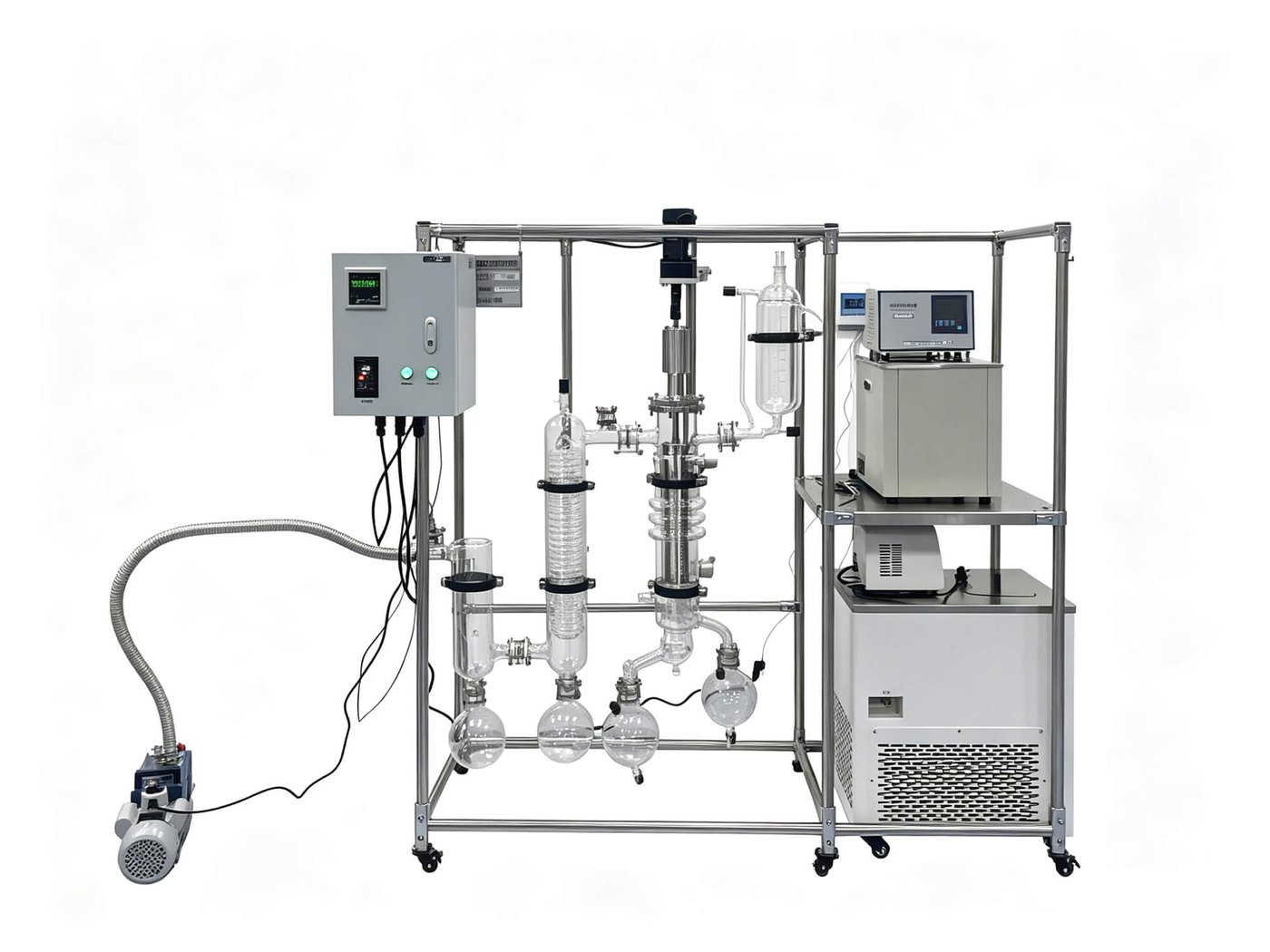
A practical guide to short-path molecular distillation — how it protects active compounds, handles high-boiling feedstocks, and why ANVORE systems are built around four core advantages.
1. Introduction
In pharmaceutical, nutraceutical, essential oil and specialty chemical production, separation efficiency directly determines product quality, yield and development timeline. Many valuable materials — cannabinoids, terpenes, fatty acids, silicone oils, pharmaceutical intermediates — share three sensitive traits: they are heat-sensitive, easily oxidized, and/or have high boiling points. Conventional distillation often fails these materials because it demands high temperatures and long residence times.
Short-path molecular distillation solves this by separating molecules based on differences in mean free path under high vacuum, rather than relying solely on boiling-point differences at atmospheric pressure. The result is a gentler, more selective separation process that preserves activity and improves purity.
This article explains the working principle of molecular distillation, compares it with traditional distillation across four critical dimensions, walks through the core structure of an ANVORE system, and shows how supporting equipment — vacuum systems, circulators and on-site nitrogen generators — complete the solution.
2. What Is Molecular Distillation?
Molecular distillation, also called short-path distillation, is a liquid-liquid separation technology carried out under high vacuum (typically 0.001–1 mbar). In this pressure range, the mean free path of vapor molecules becomes longer than the distance between the evaporator surface and the internal condenser. Molecules that reach the condenser are collected as the light fraction; those that do not travel the short gap fall back as the heavy fraction.
Because the operating pressure is extremely low, the evaporation temperature is far below the normal boiling point. Combined with a wiped-film rotor that spreads the feed into a thin liquid film and moves it rapidly across the heated surface, the material's total heat exposure is reduced from minutes or hours to just a few seconds.
3. Molecular Distillation vs. Traditional Distillation: Four Core Advantages
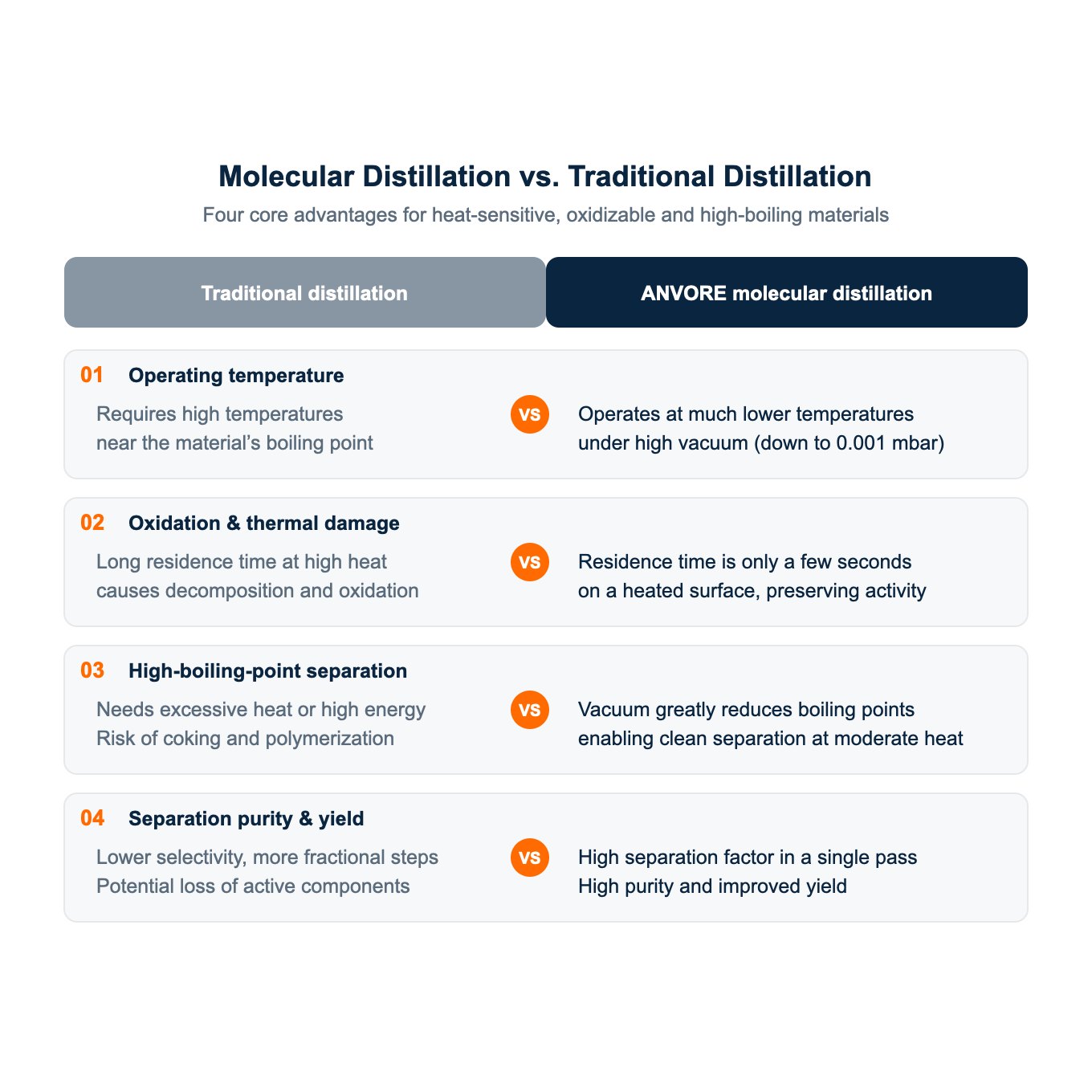
The comparison below highlights why molecular distillation is preferred for sensitive and high-boiling materials.
3.1 Lower operating temperature protects heat-sensitive compounds
Traditional distillation must heat the liquid close to its atmospheric boiling point. For many natural extracts and pharmaceutical intermediates, this causes thermal degradation, color darkening and loss of active components.
Molecular distillation reduces the boiling point by 100–200 °C under high vacuum. Active ingredients such as cannabinoids, terpenes, vitamins and peptides can therefore be separated at temperatures where they remain stable.
3.2 Short residence time prevents oxidation and decomposition
In a conventional still, the liquid can remain at elevated temperature for extended periods, increasing the risk of oxidation, polymerization and decomposition.
ANVORE molecular distillation systems use a wiped-film evaporator. The feed is distributed as a thin film across the heated cylinder and continuously renewed. Residence time on the hot surface is typically only a few seconds, minimizing thermal stress and preserving product integrity.
3.3 High-boiling materials can be separated at moderate heat
Materials with boiling points above 250 °C at atmospheric pressure are difficult to process by ordinary distillation. They require extreme heat, which promotes coking and fouling inside the equipment.
Because molecular distillation operates under deep vacuum, the same material evaporates at a much lower temperature. High-boiling specialty chemicals, silicone oils, epoxy intermediates and other viscous feedstocks can be separated cleanly without thermal damage to either the product or the equipment.
3.4 High separation factor improves purity and yield in a single pass
Traditional fractional distillation may require multiple passes or tall packed columns to reach high purity, increasing both cycle time and product loss.
Molecular distillation offers a high separation factor in a single pass. The short, well-defined path between evaporator and condenser means only molecules within a narrow molecular-weight range are collected, giving higher purity and better yield for the target fraction.
4. Structure of an ANVORE Short-Path Molecular Distillation System
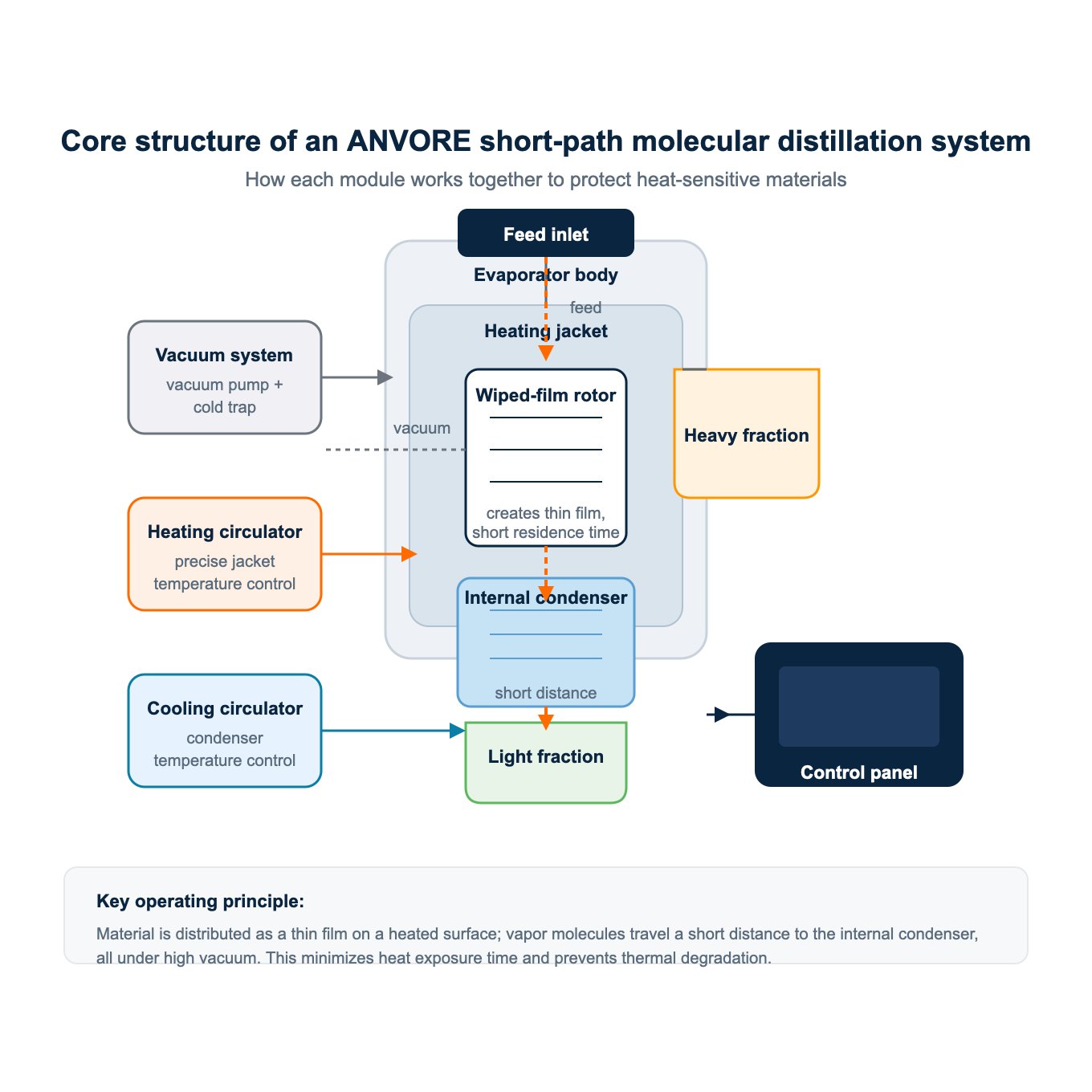
An ANVORE short-path molecular distillation unit is more than a single vessel. It is an integrated system in which every module protects the product and controls the process.
4.1 Evaporator body and heating jacket
The evaporator body houses the heated cylindrical surface. A precision heating jacket, controlled by an external circulator, maintains the exact evaporation temperature required by the process. Temperature uniformity across the wall is critical for consistent film evaporation.
4.2 Wiped-film rotor and distribution system
The rotor spreads the feed into a thin, turbulent film across the heated wall. This thin film:
- Dramatically shortens heat transfer distance;
- Reduces residence time to seconds;
- Prevents localized overheating and thermal degradation.
4.3 Internal condenser
Positioned close to the evaporator surface, the internal condenser captures vapor molecules that travel the short mean free path. Because the condensation distance is short, the process remains efficient even at very low pressure.
4.4 Vacuum system (vacuum pump + cold trap)
A high-performance vacuum pump package, protected by a cold trap, maintains the deep vacuum required for low-temperature operation. The cold trap also protects the pump by condensing volatile solvents before they enter the pump body.
4.5 Heating and cooling circulators
External circulators provide precise, independent temperature control for the heating jacket and the internal condenser. Stable temperatures are essential for reproducible separation and consistent product quality.
4.6 Control panel
The control panel integrates temperature, vacuum and rotor speed settings. An intuitive HMI allows operators to record recipes, monitor alarms and repeat validated processes batch after batch.
4.7 Fraction receivers
Two separate receivers collect the light fraction (distillate) and the heavy fraction (residue). This split is the core output of the separation process and can be fine-tuned by adjusting temperature, vacuum and feed rate.
5. ANVORE Molecular Distillation Product Range
ANVORE designs and manufactures laboratory, pilot and production-scale molecular distillation systems in both glass and stainless steel configurations.
| Series | Material | Typical scale | Best for |
|---|---|---|---|
| Glass short-path molecular distillation | Borosilicate glass | 0.1–2 L/h | Process development, visual observation, research |
| Stainless steel molecular distillation | SS316 / SS304 | 1–50 L/h and above | Pilot scale, production, viscous or corrosive materials |
| Turnkey distillation package | Glass + steel + support | Custom | Customers who need a complete, plug-and-run system |
Each system can be paired with ANVORE vacuum pumps, heating/cooling circulators and nitrogen generators to create a fully integrated separation workstation.
6. Supporting Solutions: From Vacuum to Inert Gas Supply
Efficient molecular distillation depends on reliable supporting equipment. ANVORE supplies the complete package so that customers do not need to source auxiliaries from multiple vendors.
6.1 Vacuum pumps and cold traps
Deep, stable vacuum is the foundation of molecular distillation. ANVORE systems are matched with oil-sealed rotary vane pumps, dry scroll pumps or diffusion pumps, depending on the required ultimate vacuum and solvent load.
6.2 Heating and cooling circulators
Jacket temperature and condenser temperature must be controlled independently. ANVORE circulators offer precise set-point control and wide temperature ranges to match different separation tasks.
6.3 On-site nitrogen generators
Oxygen-sensitive materials benefit from an inert atmosphere. ANVORE PSA and membrane nitrogen generators deliver nitrogen purity up to 99.999% on site, eliminating cylinder handling and ensuring a continuous, low-cost supply for blanketing, purging and instrument support.
7. Typical Applications
Molecular distillation is widely used wherever thermal protection and high purity are both required:
- Cannabis and hemp: THC/CBD isolation, terpene recovery, removal of residual solvents and waxes.
- Essential oils and flavors: Citrus terpene removal, concentration of aromatic compounds, production of perfume-grade fractions.
- Pharmaceuticals and nutraceuticals: Purification of APIs, intermediates, vitamins, omega-3 fatty acids and peptide-containing solutions.
- Specialty chemicals and new materials: Silicone oil purification, epoxy resin intermediates, nanomaterial concentration, polymer devolatilization.
8. Conclusion
For heat-sensitive, oxidizable and high-boiling materials, molecular distillation is often the only practical route to high purity without thermal damage. The combination of deep vacuum, thin-film evaporation and short residence time gives ANVORE molecular distillation systems four decisive advantages over traditional distillation: lower operating temperature, better oxidation protection, efficient high-boiling separation, and higher purity with improved yield.
Backed by ANVORE's in-house manufacturing, application engineering team and full range of supporting gas and thermal solutions, these systems help laboratories and production plants move from process development to commercial scale with confidence.
Ready to discuss your separation challenge? Contact ANVORE for a free application review or sample run.